Multiply Labs’ $75 million Series B is a bet that robots can make advanced medicines affordable at industrial scale. Arriving in the middle of a historic U.S. manufacturing buildout, it also reframes the talent question every new plant is wrestling with.
Key takeaways
- Multiply Labs, a San Francisco robotics company, raised a $75 million Series B on October 6, 2026, led by Dr. Patrick Soon-Shiong and NantWorks, bringing total funding past $100 million.
- Its robotic clusters automate manual steps in cell and gene therapy, antibody, viral vector and mRNA manufacturing, with company-reported cost-per-dose reductions of 74% and up to 100 times the throughput of manual processes.
- Lower manufacturing cost widens the path to affordability for advanced therapies, though list prices also depend on reimbursement, competition and policy.
- U.S. pharma reshoring commitments exceed $480 billion, with major projects in North Carolina, Ohio, Virginia, Maryland and Pennsylvania, and talent is the most cited constraint.
- Robotics raises the “leverage ratio,” the number of patients each skilled biomanufacturing professional can serve, shifting demand toward automation, validation, MSAT, quality and regulatory roles rather than eliminating jobs.
For more than 20 years I’ve worked at the intersection of life sciences companies and the people who build them, and I’ve watched our industry treat manufacturing as the last step: the place where brilliant science gets handed off to be produced. That ordering is starting to flip. With AI generating drug candidates faster than ever, the constraint on getting new medicines to patients is increasingly how fast, how reliably and how affordably we can make them.
That is why Multiply Labs’ $75 million Series B, announced this morning, deserves attention well beyond the venture community. The San Francisco company builds robotic systems that automate the most manual steps in producing cell and gene therapies and other advanced biologics. Its CEO, Fred Parietti, put the mission bluntly to Business Insider: “Someone has to make the drugs.”
The round lands at a moment when hundreds of billions of dollars are being committed to new U.S. drug manufacturing capacity, much of it in North Carolina, Ohio, Virginia, Maryland and Pennsylvania. Nearly every company building in those states says the same thing about the hardest part of the job: finding the people to run the plants. Robotics changes that equation, though not in the way the headlines about automation usually suggest.
Robots at the Bench, Owned by the Manufacturer
Multiply Labs was founded in 2016 out of Y Combinator by Parietti and Alice Melocchi. The Series B, led by Dr. Patrick Soon-Shiong and NantWorks, brings total funding past $100 million. New investors include AstraZeneca, Lingotto, Teradyne and Strange Ventures, joining returning backers Casdin Capital, Lux Capital, Fifty Years and Founders Fund.
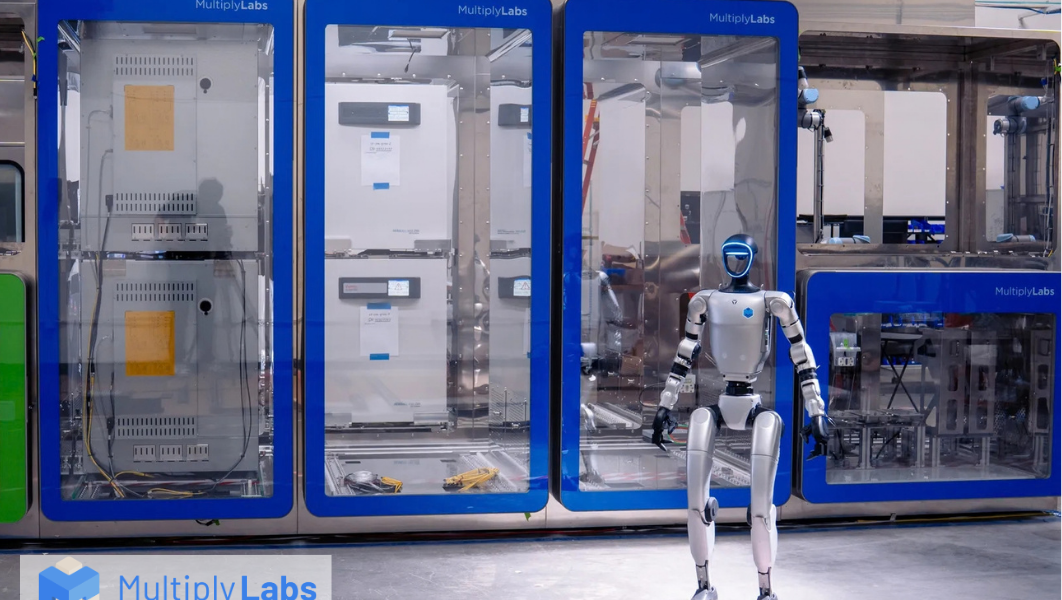
The company’s robotic clusters plug into a manufacturer’s existing instruments and validated processes rather than requiring a new facility. Each cluster runs the timed, repetitive steps of biologics production inside an enclosed, GMP-compliant system, which removes the manual handoffs where contamination risk is highest. Multiply reports a 74% reduction in cost per dose and up to 100 times the throughput of manual manufacturing. Those are company figures, and the industry will want to see them hold at commercial scale, but the direction is unmistakable.
Two details matter for anyone thinking about the workforce. First, the systems are owned and operated by the drugmakers themselves, not run as an outsourced service, so the skills to run them will live inside the companies building plants across our regions. Second, the platform started in cell therapy and is expanding into antibodies, viral vectors and mRNA. Deployments with Legend Biotech and AstraZeneca are already underway, and Y Combinator noted that the company aims to bring the price of its machines down from several million dollars to tens of thousands as production scales.
Parietti has framed the stakes in absolute terms, arguing that robotics is the only way the next generation of biological medicines reaches true industrial scale. Lingotto’s Dr. Ileana Pirozzi, who joins the board, offered the historical comparison: robotics did this for automotive and semiconductors, turning labor-intensive processes into precise, scalable production. I find that comparison useful, partly because of what happened to the workforce in both of those industries.
The Affordability Math
Cell and gene therapies are some of the most remarkable medicines ever approved, and some of the hardest to make. Y Combinator, in announcing the round, noted that certain gene therapies can cost more than $1 million per dose just to manufacture. Much of that cost traces back to skilled people performing delicate aseptic steps by hand, one patient batch at a time, where a single contamination event can wipe out a batch worth millions and delay treatment for a patient who is already waiting.
Automation attacks that cost structure directly. Fewer manual touchpoints mean fewer failed batches, and a cluster that runs continuously produces far more doses from the same footprint and the same team. If Multiply’s reported cost reduction holds anywhere near 74% in commercial production, it changes which therapies are economically viable to develop, how many patients a single facility can serve, and how far beyond academic medical centers these treatments can reach.
I want to be careful here, because lower manufacturing cost does not automatically become a lower price at the pharmacy counter. List prices reflect R&D risk, reimbursement, competition and policy as much as cost of goods. What cheaper, more reliable manufacturing does is widen the room for affordability. It makes room for more competitors, for therapies aimed at smaller patient populations, and for the personalized medicines AI is now designing that would never pencil out on a manual process. That is a real contribution to access, and it is the honest version of the affordability argument.
Billions in Steel, and the People to Run It
This round arrives in the middle of the largest domestic manufacturing buildout our industry has seen. Announced U.S. reshoring commitments now exceed $480 billion across 22 sites and roughly 44,000 jobs, and North Carolina, Ohio, Virginia, Maryland and Pennsylvania are carrying a large share of it.
| State | Company | Project | Investment | Jobs cited |
|---|---|---|---|---|
| Virginia | AstraZeneca | Drug substance facility, Charlottesville | $4.5B | |
| Maryland | AstraZeneca | Frederick biologics expansion and Gaithersburg clinical-scale facility | $2B | 2,600 |
| North Carolina | Johnson & Johnson | Biologics campus in Wilson, plus a second Wilson facility | $2B+ | 420 + up to 500 |
| North Carolina | Genentech | Holly Springs biomanufacturing facility | ~$2B | |
| Pennsylvania | Eli Lilly | Lehigh Valley manufacturing facility | $3.5B | 850 |
| Ohio | Amgen | New Albany expansion within a $1.4B plan | $900M | 750 |
| Ohio | Bayer | New Albany drug substance and drug product campus (first module 2031) | $2.2B | ~600 |
| Ohio | Eli Lilly and Resilience | Cincinnati-region sterile injectable and KwikPen device expansion | $750M | 400+ |
That list leaves out a great deal, including GSK’s new biologics factory at Upper Merion, Amgen’s Holly Springs expansion, J&J’s planned cell therapy site in Pennsylvania and AstraZeneca’s new cell therapy manufacturing facility in Rockville. It is worth pausing on that last one. AstraZeneca is now an investor in, and a customer of, a company automating cell therapy production, while it builds cell therapy capacity in the heart of the BioHealth Capital Region.
The constraint on all of this is people. Carolyn Durham’s recent piece in MedCity News makes the case well: the credentialed talent pool needed to run a modern plant, from GMP-trained engineers to DeltaV automation specialists to sterile operators, is narrow and slow to grow. Semiconductor fabs and data centers are recruiting from the same bench in many of the same places. BioSpace, citing BioPlan research, reports that 36% of facilities can’t hire process development staff, 28% struggle to fill downstream production roles and 27% lack enough process engineers.
The Leverage Ratio
The common reflex is to read a story like Multiply’s as a jobs story with a villain: robots arrive, people leave. I see something different, and I think the more useful way to frame it is what I’d call the leverage ratio, meaning the number of patients a single skilled biomanufacturing professional can serve.
In a manual cell therapy suite, that ratio is low by necessity. A highly trained operator spends hours in a gown performing precise, repetitive manipulations, and each batch serves one patient. Our current hiring model assumes that ratio is fixed, so every new facility is planned as a headcount problem: more patients require proportionally more operators, and the industry competes for a pool that MedCity, BioSpace and every site selection consultant agree is too small.
Robotics raises the leverage ratio. When a cluster handles the timed, repetitive steps, each skilled person oversees more batches, catches more deviations and supports more patients. The talent constraint doesn’t disappear. It shifts from a question of how many people we can find to a question of which skills we can build and how well we deploy them. That second question is one our regions can actually answer, and it is the one I’d rather be working on.
This is also why I don’t see automation and reshoring as competing stories. The billions being committed to North Carolina, Ohio, Virginia, Maryland and Pennsylvania will be most productive in the facilities that pair new capital with higher-leverage teams. Plants that plan to scale advanced therapies on a purely manual model are likely to feel the hiring pressures described above most acutely.
What Changes on the Plant Floor
If the leverage ratio rises, the work changes shape. Fewer hours go to repetitive manual manipulation inside a biosafety cabinet, and more go to the jobs that keep automated systems qualified, running and improving. Those include automation engineers and robotics technicians, validation and commissioning specialists, quality professionals who can review electronic batch records and system data, manufacturing science and technology (MSAT) teams who tech-transfer processes onto new platforms, and regulatory staff who can explain an automated process to FDA.
Many of those roles already sit at the top of the shortage lists. The DeltaV automation specialists MedCity flags are exactly the kind of people a robotics-enabled plant needs more of. Multiply itself says it will use this capital to grow its team across engineering, regulatory and commercial functions, and every customer that installs a cluster will need people on site who can run and maintain it.
The automotive and semiconductor comparison is instructive here. Both industries automated heavily and kept expanding output, and the skills they hired for shifted toward technicians, engineers and process specialists. Biomanufacturing will not follow the same path exactly, but if automation brings costs down and opens the door to more therapies reaching more patients, the volume of manufacturing grows, and so does demand for people who can run it. The operators doing manual aseptic work today are not a workforce to be replaced. They are among the best-positioned people to move into those higher-leverage roles, because they already understand the process, the GMP culture and the stakes.
Building for the Plant of 2029, Not 2026
Most of the facilities announced over the past 18 months will come online in the back half of this decade. AstraZeneca’s new Gaithersburg facility is expected to be operational in 2029, and the first module of Bayer’s $2.2 billion campus in New Albany, Ohio, is slated for 2031. Bayer says that campus is being designed around advanced digital and automation technologies from the start. The workforce plans being written today should be built for the level of automation those plants will run with when they open, not the manual processes common today. That has practical implications for everyone in our ecosystem.
For employers, it means planning the skill mix the way you plan capacity. The question to ask is how many automation, validation, MSAT and data-literate quality professionals each production line will need, and where those people will come from. That includes deliberately upskilling the operators already on your floor, who carry the process knowledge no new hire will have on day one.
For educators and training partners, it means automation literacy belongs in the core curriculum, not an elective. North Carolina is showing what serious investment looks like: community colleges there have committed more than $230 million to biomanufacturing training, including NC State’s BTEC and a new BEST Center at Wilson Community College designed to train up to 500 people a year. Ohio has added biomanufacturing to its state manufacturing competency model. Programs like these should be teaching people to work alongside robotic systems from their first week.
For states and economic developers competing for the next site selection decision, it means talent strategy is part of the incentive package. As MedCity argued, apprenticeships alone won’t close the gap. Regions that can show a pipeline of automation-ready biomanufacturing talent, drawn from adjacent industries like semiconductors and medical devices as well as traditional life sciences, will have an advantage in winning the next wave of investment.
This is the core of what I’ve come to call Talent Logistics: treating the biomanufacturing workforce as a supply chain that has to be forecast, built and routed with the same rigor we apply to raw materials and capacity. Multiply Labs is betting that robots can make advanced medicines at industrial scale. I think they’re right about the direction. Getting there will depend on the people who build, run and continuously improve those systems, and on whether we start preparing them now, while the steel is still going up.
Frequently Asked Questions
What is Multiply Labs?
Multiply Labs is a San Francisco robotics company, founded in 2016 through Y Combinator, that builds robotic systems to automate the manufacturing of advanced biologics. In October 2026 it raised a $75 million Series B led by Dr. Patrick Soon-Shiong and NantWorks, with AstraZeneca among the new investors. Its systems are owned and operated by drugmakers, including customers AstraZeneca and Legend Biotech.
How does robotics lower the cost of cell and gene therapy manufacturing?
Much of the cost of cell and gene therapy comes from skilled operators performing manual aseptic steps one batch at a time, where a single contamination event can destroy a batch. Robotic systems run those repetitive steps in enclosed, GMP-compliant environments, reducing failed batches and producing more doses from the same facility. Multiply Labs reports a 74% reduction in cost per dose and up to 100 times the throughput of manual manufacturing.
Will robotics eliminate biomanufacturing jobs?
Automation is more likely to change biomanufacturing jobs than eliminate them. As robots take over repetitive manual steps, demand grows for automation engineers, robotics technicians, validation specialists, MSAT teams, data-literate quality professionals and regulatory staff. If lower costs lead to more therapies being produced, overall manufacturing volume and hiring can grow as well.
What is the leverage ratio in biomanufacturing?
The leverage ratio, a framework from Chris Frew of BioBuzz Networks, is the number of patients a single skilled biomanufacturing professional can serve. Manual processes keep that ratio low, which turns every new facility into a headcount problem. Automation raises the ratio, shifting the talent challenge from finding more people to building the right skills.
Where is U.S. pharmaceutical manufacturing investment concentrated?
Announced U.S. reshoring commitments exceed $480 billion across 22 sites. Major projects include AstraZeneca in Virginia and Maryland, Johnson & Johnson and Genentech in North Carolina, Eli Lilly in Pennsylvania, and Amgen, Bayer and Eli Lilly with Resilience in Ohio.
What skills will automated biomanufacturing plants need?
Automated plants need people who can qualify, run and improve robotic and digital systems. Priority skills include automation and control systems such as DeltaV, equipment validation and commissioning, technology transfer, electronic batch record review, data integrity and regulatory communication with FDA. Experienced GMP operators are well positioned to move into these roles with targeted upskilling.
Chris Frew is the CEO of BioBuzz Networks and Workforce Genetics. He has spent more than 20 years working in the life sciences workforce space across the BioHealth Capital Region, Greater Philadelphia and Research Triangle Park.