
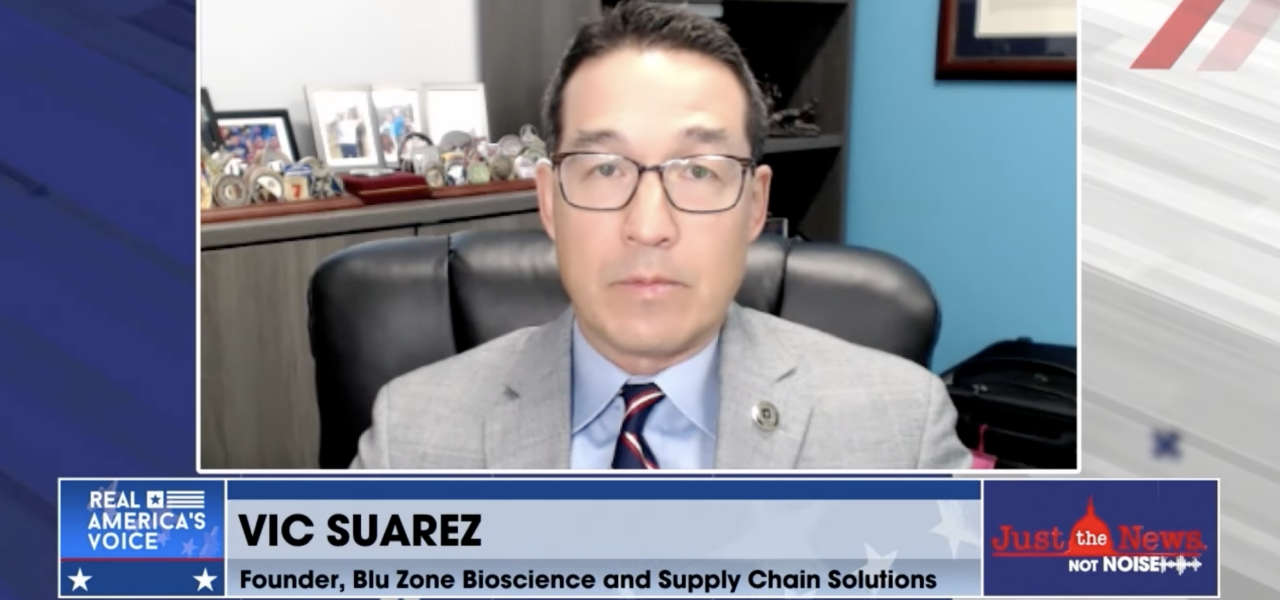
Retired Colonel Vic Suarez is Leading the Charge to Build America’s Strategic Drug Reserve to secure essential drugs for America’s troops and citizens alike.
Retired Colonel Vic Suarez, founder of Blu Zone Bioscience sat down for a recent interview where sounded a wake-up call for an urgent situation impacting both troops and citizens. A career Army officer who once oversaw pharmaceutical logistics for America’s special forces, Suarez described something he never thought possible: U.S. frontline units unable to access the basic trauma medicines needed to save lives.
That stark reality—once unimaginable—has become a national wake-up call. His testimony before Congress exposed America’s dangerous reliance on foreign suppliers, including strategic rivals, for critical drugs and active pharmaceutical ingredients. What began as a supply-chain issue has now emerged as a clear threat to national security.
The Strategic Risk: A Supply Line Under Siege
The vulnerability Suarez identified isn’t abstract—it strikes at the heart of military readiness and civilian health alike. For decades, the U.S. ceded pharmaceutical manufacturing to lower-cost countries, gradually losing control over the active ingredients and finished medicines that sustain both everyday care and battlefield survival. Today, roughly one-fifth of active pharmaceutical ingredients used in the United States come from China, and nearly half of the key starting materials originate abroad.
In his April 2024 Senate testimony, Suarez put it bluntly: “I pray the day never comes … when our men and women in combat find themselves without the drugs needed to save their lives.” That warning underscored what lawmakers had largely overlooked—that the drug shortages making headlines in hospitals are equally, if not more, dangerous on the battlefield.
Suarez’s warnings were not hyperbole. According to the U.S. House Select Committee on China’s December 2023 report, 20% of active pharmaceutical ingredients (APIs) and 45% of key starting materials (KSMs) come from China—a precarious choke point. Suarez emphasized the human cost of this reliance, recalling patients who, having fought cancer, lost access to their life-saving drugs.
These dependencies are not accidental. Drifting profit margins, driven by policies like the Hatch-Waxman Act, pushed generic production abroad, where lower costs came at the expense of quality and oversight.
From Warning to Action: SAPIR Becomes Momentum
Suarez’s testimony was more than a warning—it was a turning point. Within a year, the urgency he described had made its way into the Oval Office. In August 2025, the administration issued an executive order creating the Strategic Active Pharmaceutical Ingredients Reserve (SAPIR)—a first-of-its-kind national stockpile of 26 essential APIs. Managed by the Department of Health and Human Services, SAPIR is designed to give the U.S. breathing room in a crisis, ensuring that soldiers on the frontlines and patients in hospitals aren’t left waiting for medicine that may never arrive.
Crucially, SAPIR is more than just a warehouse of chemicals. It signals a broader strategic shift: away from decades of dependence on adversarial nations and toward building domestic resilience. This shift is being powered not only by government policy but by a new wave of U.S. companies reimagining how medicine can be manufactured, stored, and distributed.
Standing Up U.S. Manufacturing: Local Heroes Leading the Way
Forward-thinking companies are turning the blueprint into reality. In Richmond, Virginia, Phlow Corp. is accelerating domestic capability with a public-benefit CDMO focused on small-molecule API development and manufacturing—all on U.S. soil. Its state-of-the-art analytical labs, powered by AI and continuous-flow chemistry, are designed to deliver modern, reliable, high-quality medicines at scale. Notably, HHS leadership toured Phlow’s integrated facilities—including kilo-scale and metric-ton manufacturing lines—to witness end-to-end U.S. production in action.
Meanwhile, in Rockville, Maryland, On Demand Pharmaceuticals (ODP) is pioneering a radically scalable, decentralized model. Its flagship Pharmacy on Demand® (PoD) platform produces sterile medications on-site or near point-of-care, using AI-driven real-time controls. HHS officials recently visited ODP’s Centralized Production and Repackaging facility to watch live: PoD formed essential medicine in real time—showcasing plug-and-play resilience for emergencies.
These innovators are more than contract manufacturers—they’re the engines powering future-proof U.S. drug sovereignty.
Blueprints for Self-Reliance: Tech-Led Manufacturing Ecosystem
Col. Suarez envisions a future built not just on quantity, but on quality, agility, and security. He’s seen the shift away from low-cost, toxic-solvent-heavy overseas production and toward continuous manufacturing, AI-driven oversight, and desktop-scale units capable of precise, small-batch production. “When we can pivot to continuous manufacturing, we produce higher-quality yields,” he told a panel last year.
These innovations align perfectly with what Phlow and ODP are already delivering—proof that Suarez’s vision is operational today.
Systemic Solutions in Motion: APIIC and Federal Strategy
While stockpiles and new manufacturing technologies are critical, Suarez argues that lasting resilience requires systemic reform. That’s why in March 2025, he joined the API Innovation Center (APIIC)—a coalition of manufacturers, policy experts, and healthcare leaders—to co-author a comprehensive white paper on America’s pharmaceutical future. It provided some key recommendations:
- Upgrading underused U.S. facilities with advanced manufacturing technologies (AMTs), backed by government volume and R&D commitments.
- Closing procurement loopholes that obscure foreign-made APIs as “U.S.-made.”
- Prioritizing quality over lowest cost, expanding buffer inventories, and appointing a centralized drug-supply coordinator.
- Emphasizing transparency and reliability to rebuild trust in domestic production—“You have to have a level of transparency, a level of reliability and a level of quality,” Suarez said.
Why It Matters: Health-Security = National Security
America in 2025 imported $96 billion worth of medicines, weakening our domestic industrial base and exposing vulnerabilities. Needless to say, when even soldiers can’t access daily trauma drugs, the nation’s credibility—and lives—are on the line.
Drawing on his Army logistics experience, Suarez warns: “these issues … represent a growing, existential public health threat to the United States.” What’s different now is that action has followed alarm.
From Reliance to Reinvention
Col. Suarez’s vision is bold but executable:
- Strategic Stockpiling — via SAPIR and buffer inventories.
- Tech-led On-shoring — continuous manufacturing, AI-driven labs, and desktop-scale PoD models. (Enter Phlow & ODP.)
- Systemic Reform — closing loopholes, incentivizing quality, and aligning procurement policy.
- Whole-of-Government Coordination — integrating public and private players under one resilient strategy.
These are far from hypothetical—they are unfolding in real time with private-public synergy.
Ret. Col. Vic Suarez has helped to ignite a critical national movement. U.S. pharmaceutical security is now anchored by policy momentum, technological innovation, and companies like Phlow and On Demand Pharmaceuticals translating vision into capability.
As Suarez said, “I pray the day never comes … when … men and women in combat … are without the drugs needed to save their lives.” Thanks to committed leadership and tangible progress, that day may never come—not on his watch.
Citations
- U.S. Senate Armed Services Committee, Statement of Ret. Col. Vic Suarez (April 2024):
https://www.armed-services.senate.gov/imo/media/doc/suarez_statement.pdf - U.S. House Select Committee on China, Pharmaceutical Supply Chain Report (Dec 2023)
- Reuters, “Trump Signs Order to Ensure Resilient Supply Chain of Essential Medicines” (Aug 2025):
https://www.reuters.com/business/healthcare-pharmaceuticals/trump-signs-order-ensure-resilient-supply-chain-essential-medicines-us-2025-08-13 - Council on Strategic Risks, “The National Security Rationale for Stockpiling Key Pharmaceutical Ingredients” (Mar 2024):
https://councilonstrategicrisks.org/2024/03/05/the-national-security-rationale-for-stockpiling-key-pharmaceutical-ingredients - Phlow Corp., company announcements and facility expansion reports (2025):
https://www.phlow-usa.com - Virginia Bio, “Phlow Expands Analytical Capabilities and Embraces AI Systems” (2025):
https://www.vabio.org/phlow-corp-expands-analytical-capabilities-and-embraces-artificial-intelligence-driven-system-ushering-in-a-new-era-of-modern-medicine-manufacturing-in-america - American Hospital Association, “HHS Leaders Visit Phlow to See U.S. Medicines Made Start-to-Finish” (July 2025):
https://www.aha.org/news/headline/2025-07-10-hhs-leaders-visit-phlow-corp-campus-see-pharmaceuticals-made-start-finish - On Demand Pharmaceuticals, PoD technology overview:
https://ondemandpharma.com - PR Newswire, “On Demand Pharmaceuticals Welcomes HHS Leadership to Showcase Breakthrough Domestic Capabilities” (Aug 2025):
https://www.prnewswire.com/news-releases/on-demand-pharmaceuticals-welcomes-hhs-leadership-to-showcase-breakthrough-domestic-pharmaceutical-manufacturing-capabilities-302530218.html - Global Biodefense, “On Demand Pharmaceuticals Opens Maryland Facility” (Feb 2022):
https://globalbiodefense.com/2022/02/17/on-demand-pharmaceuticals-opens-state-of-the-art-manufacturing-facility-in-maryland - API Innovation Center, Building a Resilient Domestic Drug Supply Chain: White Paper (Mar 2025):
https://apicenter.org/wp-content/uploads/2025/03/APIIC-White-Paper-2025-Building-a-Resilient-Domestic-Drug-Supply-Chain.pdf - U.S. Army University Press, “Medicine as Ammunition” (2025):
https://www.armyupress.army.mil/journals/military-review/online-exclusive/2025-ole/medicine-as-ammunition - Art of Procurement, “America’s Pharmaceutical Independence” (2024):
https://artofprocurement.com/blog/supply-sending-a-powerful-message-about-americas-pharmaceutical-independence - U.S. Trade Data, Pharmaceutical Import Deficit (2021):
https://dataweb.usitc.gov