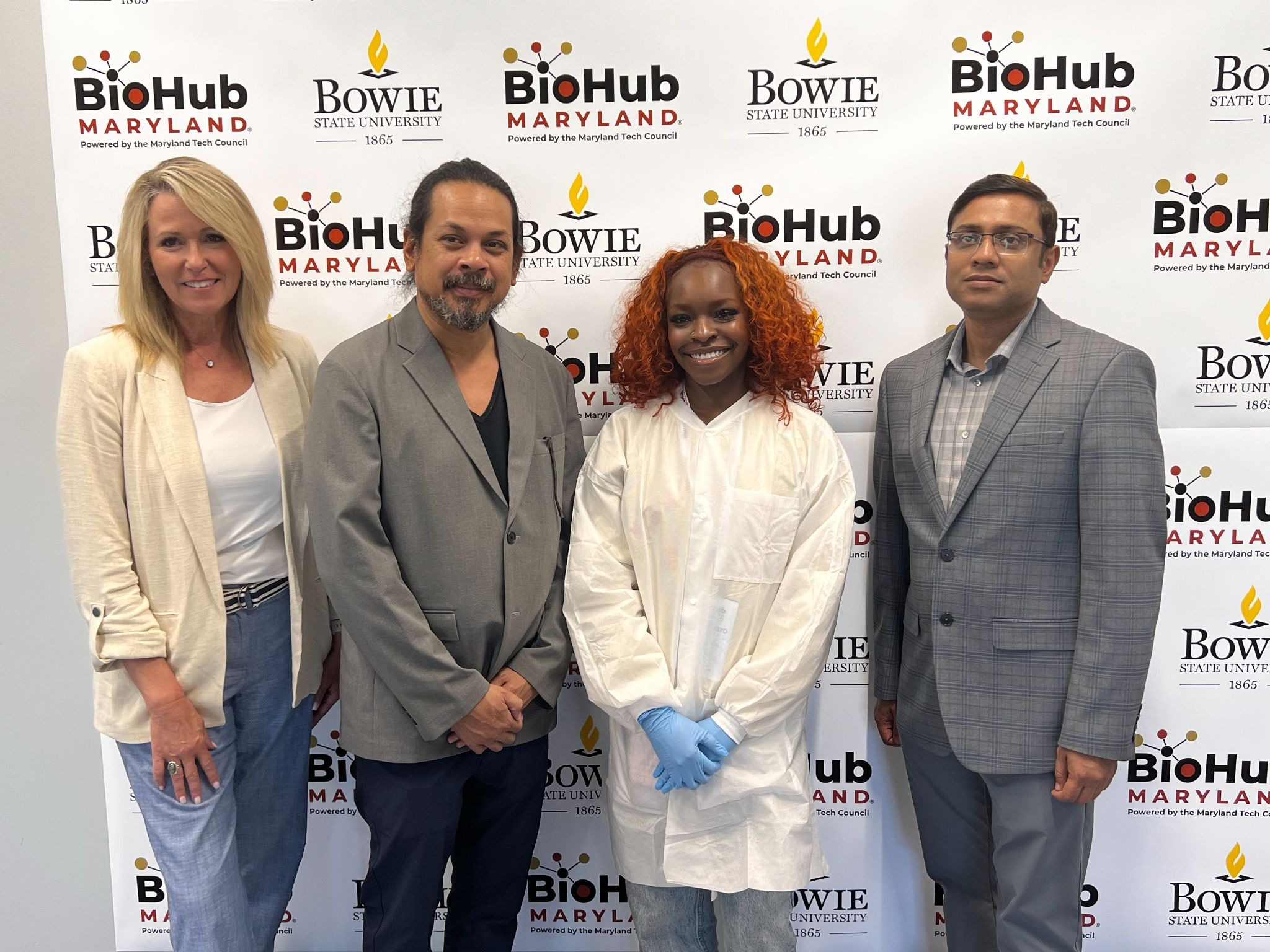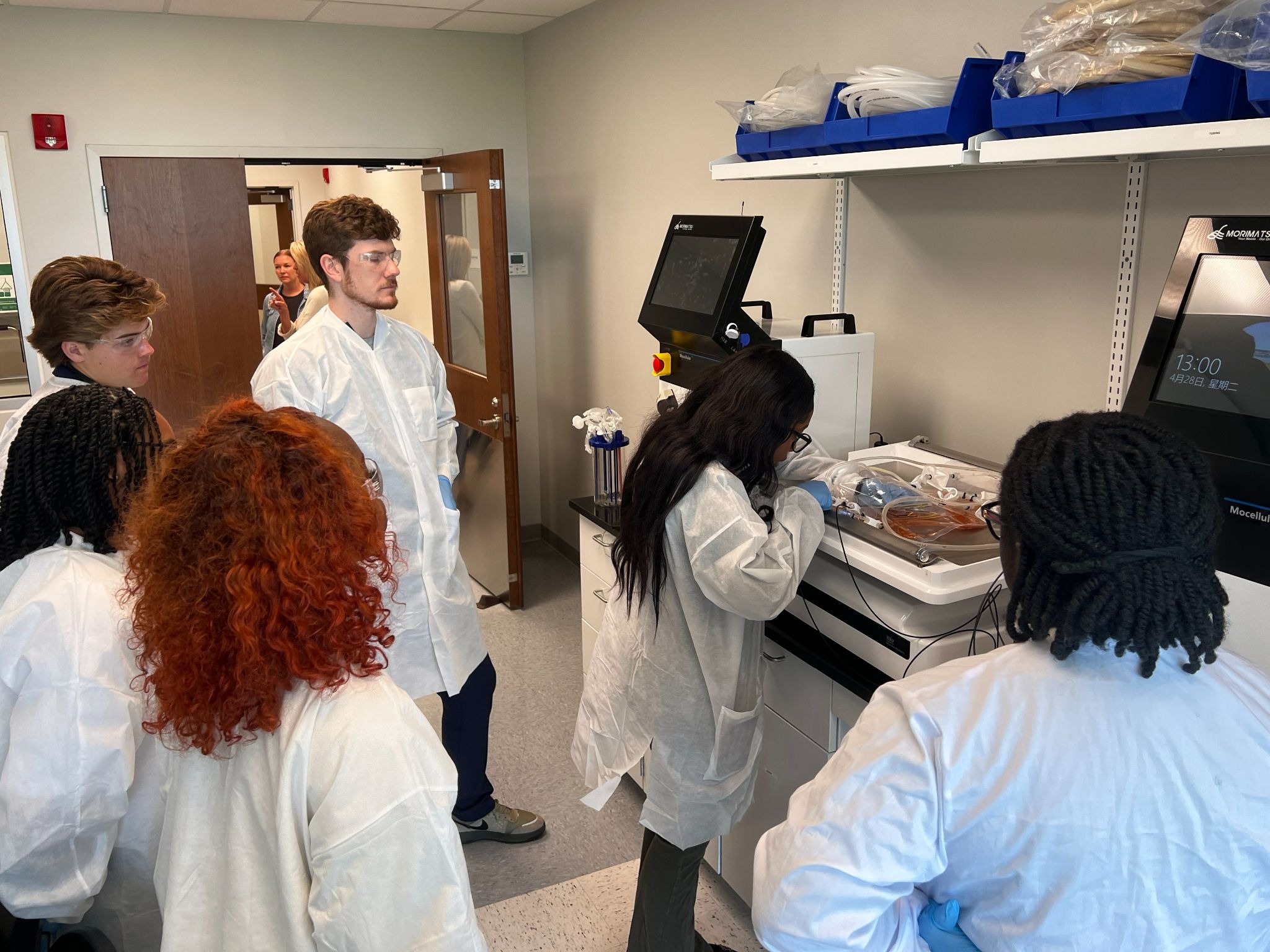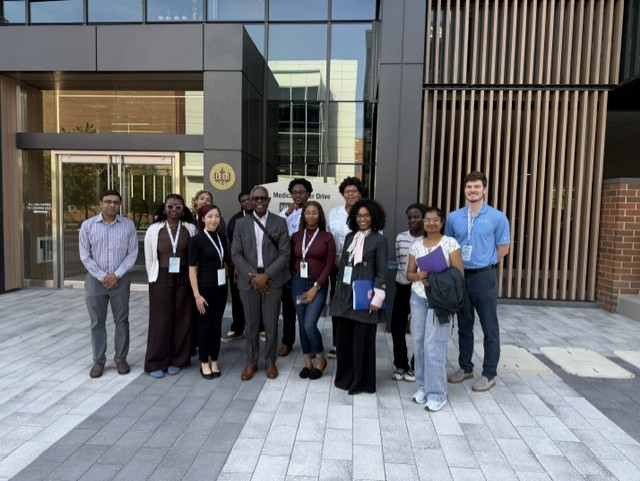
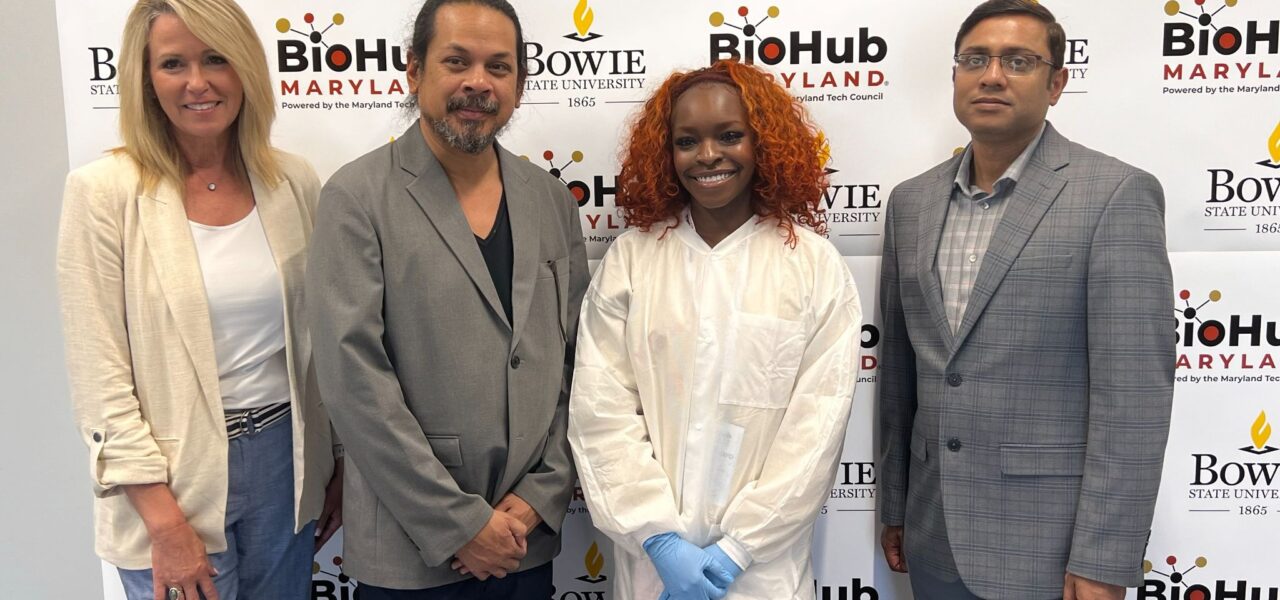
The BioHub Maryland–Bowie State partnership is giving students hands-on biomanufacturing experience while reshaping how they approach lab work, career planning, and the life sciences job market
This summer, the program completed its second full year, training students in cohorts through an immersive, lab-based program built around core concepts like upstream processing, cell culture, and quality control, modeled on the curriculum of NIBRT, the Dublin-based National Institute for Bioprocessing Research and Training. In total, 48 Bowie State students have completed the training since the partnership began in 2025, and Bowie State remains the only HBCU currently participating in this hands-on BioHub Maryland biomanufacturing partnership, helping prepare the next generation of talent for opportunities in Maryland’s growing life sciences workforce.
The partnership was created in response to a gap identified by Maryland’s Life Sciences Advisory Board: biotechnology and biopharmaceutical companies across the state were struggling to fill entry-level roles even as the industry continued to grow. Maryland is home to more than 2,700 life sciences companies and roughly 54,000 life sciences workers, within the broader BioHealth Capital Region. The demand existed, the pipeline into it needed to be strengthened.
“Students really don’t know how to conduct themselves in the industry, what the industry is looking for,” and on the other end “there is no communication about what is actually required. Therefore showing students that direction through hands-on learning matters so much, said Dr. Supriyo Ray, Associate Professor at Bowie State, who alongside Dr. George Ude, Chair of the Department of Natural Sciences, secured the National Institute of Standards and Technology (NIST) grant that made the program possible. Dr.Ude added “By integrating hands-on research experiences into our curriculum through Course-based Undergraduate Research Experiences (CURE) and now extending that foundation with specialized training through BioHub Maryland, we are giving our students a direct pathway from the classroom to the industry floor.”
BioHub Maryland, a workforce initiative powered by the Maryland Tech Council, addresses that gap by licensing curriculum from NIBRT, an Irish organization recognized globally for bioprocessing research and training. The Maryland Tech Council holds licensing rights for Maryland, DC, and Virginia, and delivers the training at BioHub Maryland’s 8,200-square-foot facility in Rockville.
The program was born out of an industry assessment that identified a clear gap in entry-level skills training, one that required a faster, more hands-on, industry-aligned model to complement traditional higher education pathways. For Kelly Schulz, CEO of the Maryland Tech Council, Bowie State represents the first implementation of a broader workforce development model.
According to Dr. Ray, the training’s core value lies in the vocabulary and context it provides. “Each terminology that you learn there is a job opportunity,” he said. Before the training, most students had never encountered terms like upstream or downstream processing, or the career paths tied to them. Ms. Gabine Oboulougou, a Bowie State junior, participated to better understand how biopharmaceutical companies actually function and came away with a clearer sense of career paths she hadn’t considered before. “It gave me an option on what I can do in life,” she said. Christiana Smith, a second-year graduate student in Applied Molecular Biology and Biotechnology, joined the program hoping to master specific lab skills. She credited the way the course was structured, along with the instructor’s guidance, for helping her understand how current companies are using specific technologies. The training confirmed she was on the right path, she said, and left her motivated to continue toward a future in research and development. Across interviews, students described the training less as a single technical experience and more as a new frame of reference for understanding where they could fit within the industry.
Dr. Ray said one of the more notable outcomes over the program’s two years has been how the training changes students’ relationship to material they’ve already studied and how they approach classwork. “Some of the students just took biochemistry with me in the spring,” he said. “Now suddenly they’re seeing how this is all relevant.” He has observed students asking more questions in class and connecting concepts to specific industry applications. “Our pre- and post-survey results confirm what I saw firsthand: students left this program more confident, more skilled, and more prepared for careers in life sciences. This partnership with BioHub Maryland has had a lasting impact on their professional growth and aspirations” said Dr. Faezeh Fatemi, Research Program Coordinator.
For Makayla Green, a rising senior on the pre-med track, the training reshaped her understanding of the field. Seeing the number of steps and safeguards involved in manufacturing a single drug gave her a clearer sense of why healthcare costs and procedures are structured as they are. Most participants, Dr. Ray noted, still enter the program with pre-med ambitions. The goal is not to redirect them away from medicine, but to expose them to a viable alternative path they may not have otherwise considered.
Several students pointed out the small, procedural details as what stayed with them most. Green said she now wipes her lab hood a certain way and understands why specific alcohol concentrations are used for sterilization, habits she said have made her more effective in her own labwork. For, Andrea Alice Abraham, who completed the training in the program’s first year, said her focus has been on the critical nature of small details, things as simple as properly wiping down surfaces and how she’s continued to apply them in her work.The training, she said, helped her build a real discipline around following protocols, one that continues to shape how she works today. Dr. Ray called these non-negotiable skills , often overlooked, but baseline knowledge every student is expected to have the moment they step into industry, he’s glad to see students walking in informed. He added that Mr. Cory Harrington, a Bioprocess Training Specialist at BioHub and also NIBRT instructors, who train cohorts at institutions across the country, describes Bowie State students as among the most curious they work with.
The Future Forward
Dr. Ray is currently applying for renewed grant funding to continue the program into a third year and expand beyond the 48 students trained to date. Schulz said BioHub Maryland’s five-year plan includes hiring additional trainers and extending the model to other colleges and universities across the state, with Bowie State serving as the initial proof of concept “This partnership is a classic example of the hallmark BSU experience -our goal is to ensure that when our students graduate, they are not just academically prepared, but truly workforce-ready, equipped with the technical skills, confidence, and industry exposure that today’s biotechnology and biopharmaceutical employers are looking for” said Dr. Steven Damo, Dean College of Arts & Sciences (CAS).