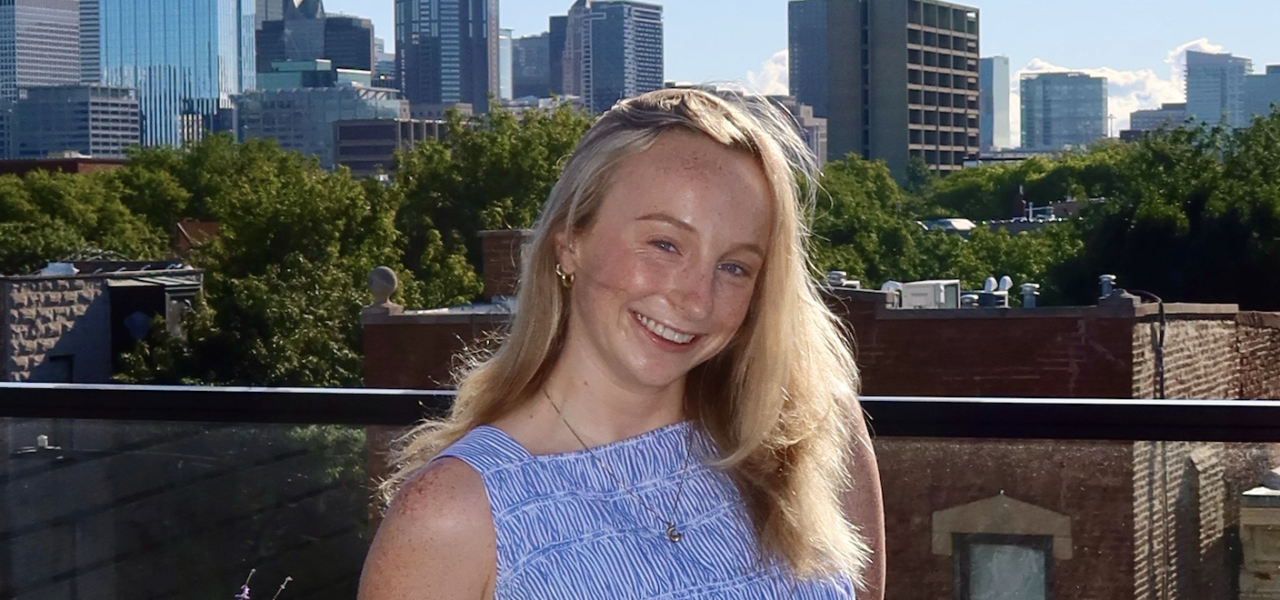
BioBuzz’s Buzzin’ Brood Student Spotlight series celebrates the future of life sciences talent — and the programs, institutions, and organizations investing in them.
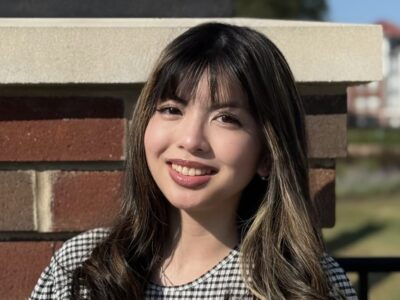
Name: Caitlin Madden
Hometown: Baltimore, Maryland
Institution: University of Illinois Chicago
Degree: PhD, Biomedical Sciences: Neurobiology (in progress); B.S. Behavioral and Cognitive Neuroscience, University of Maryland
Cohort: 2025
Role: Graduate Student, Luján Lab
Clubs/Activities: Women in Science Chicago, GEMSSA social chair board, run club leader
For Caitlin Madden, the best part of research is the moment an experiment finally gives you an answer, and you realize you’re the first person in the world to know it. She found that feeling during two years at the National Institutes of Health, where, after graduating from the University of Maryland, she studied PIEZO2, a mechanosensitive ion channel that helps turn physical sensations into signals the brain can interpret, as an Intramural Research Training Award fellow.
Now a PhD student in Biomedical Sciences: Neurobiology at the University of Illinois Chicago, Caitlin is the first graduate student in Miguel Luján’s lab, where she studies the role of the endocannabinoid system in opioid use disorder. Using fiber photometry and operant conditioning, she tracks how endocannabinoids are released in the brain during drug-seeking behavior. Along the way, she has helped build the lab from the ground up, from setting up protocols to mentoring technicians and undergraduates, and has been working to connect the lab with addiction recovery clinics in Chicago.
Outside the lab, she’s a member of Women in Science Chicago, serves on the social chair board for UIC’s GEMSSA graduate student group, and leads a local run club. She recently ran her first marathon in Berlin and is training for Paris next.
We sat down with Caitlin to learn more about her path into neuroscience, what’s exciting her right now, and where she hopes to go next.
How did you get here?
I’ve always loved understanding how things work, especially in biology. It didn’t always come easy, but I never minded putting in the work to figure it out. Psychology fascinated me in much the same way, and neuroscience felt like a natural intersection of the two: a field where different branches of science come together to understand the brain and behavior, and where I could explore a little bit of everything.
After graduating from the University of Maryland, I wanted to find out if research was something I could see myself doing long-term. I joined the National Institutes of Health through an Intramural Research Training Award and spent two years studying PIEZO2, a mechanosensitive ion channel involved in translating physical sensations into signals the brain can interpret. That experience is where I fell in love with research. It wasn’t necessarily the techniques or the day-to-day work that drew me in, but the moment an experiment finally gives you an answer and you realize you’re the first person in the world to know something.
By the time those two years were over, I knew I wanted to pursue a PhD. I was drawn to Chicago as a place to continue my training, but I also wanted to explore a question that had interested me for a long time: how drugs change the brain. I wanted to work in a lab that pushed the boundaries of what we could study, using some of the most advanced tools available in the field. Joining a new lab felt like an opportunity to help build something from the ground up while contributing to exciting science. That brought me to Miguel Luján’s lab at the University of Illinois Chicago, where I study the role of the endocannabinoid system in opioid use disorder. Using fiber photometry and operant conditioning, I track how endocannabinoids are released in the brain during drug-seeking behavior, and what that tells us about how the system contributes to addiction. It’s a young, energetic lab with people I enjoy working alongside, and we’re using cutting-edge tools to tackle some of the biggest unanswered questions in the field.
What is currently blowing your mind right now?
One thing that’s really blowing my mind right now is the growing research into psychedelics as potential treatments for substance use disorders. For a long time, addiction treatment has largely focused on managing withdrawal symptoms, reducing cravings, or helping people maintain abstinence. Psychedelics are opening up a very different conversation about whether we can use a single or limited number of treatments to produce lasting changes in the brain that support recovery.
What’s especially interesting to me is the neuroscience behind it. Substances like psilocybin appear to influence neuroplasticity and the brain’s ability to reorganize its connections. Researchers are investigating whether these changes, combined with psychotherapy, can help disrupt deeply ingrained patterns of behavior associated with addiction. The idea that we might be able to use a drug to help the brain become more receptive to change, rather than simply blocking the effects of another drug, is fascinating.
Since I study the endocannabinoid system and its role in opioid use disorder, I’m particularly interested in how different systems in the brain contribute to addiction and recovery. It’s exciting to watch a field that has historically had relatively few treatment options explore such fundamentally different approaches. There’s still a lot we don’t understand, but that’s what makes the research so exciting to follow.
If you could explain yourself right now in only emojis…
👩🏼🔬🏃🏼♀️🪩🍪😁
👩🏼🔬 — I’m a PhD student, and most of my life revolves around science.
🏃🏼♀️ — I just ran my first marathon in Berlin, and I’m training for my next one in Paris! I’m also a leader at a run club here in Chicago.
🪩🍪😁 — I love a good night out with friends, I love baking for people, and I bring my bubbly and high-energy personality into everything I do.
If you could travel into the future… what does your LinkedIn headline say?
Addiction Neuroscientist | Bridging Scientific Discovery and Clinical Practice
Ten years from now, I hope to be leading a research program studying addiction, likely still somewhere in the endocannabinoid and opioid space, using whatever new technologies are pushing the field forward. I came into research because I loved the idea of discovering something no one else knew, and that excitement hasn’t gone away. Over time, though, I’ve realized that what I want just as much is to build an environment where other people can experience that same excitement, find their footing as scientists, and develop ideas of their own.
Being the first graduate student in a brand-new lab has given me an early glimpse of the kind of investigator I want to become. I’ve had the opportunity to help build a lab from the ground up, from establishing protocols and systems to shaping the culture that future trainees will inherit. I’ve also discovered how much I enjoy mentoring our technicians and undergraduates. I want to be part of an environment where training and mentorship are considered just as important as the science itself.
I’m also interested in exploring the industry side of science, particularly the role of a medical science liaison. I love learning about new discoveries, but I’m equally interested in communicating that science and connecting the people doing the research with the people who can put it into practice. The opportunity to stay close to cutting-edge research while helping bridge the gap between scientific discovery and clinical application really appeals to me.
Regardless of which path I take, I want to keep the people behind the science in view. I’ve been working to build connections between my lab and addiction recovery clinics in Chicago because I don’t want to spend my career studying addiction without ever connecting with the people experiencing it.
I’d especially love to connect with people whose careers have taken them beyond the traditional boundaries of academia or industry, whether that’s investigators working closely with clinical communities, MSLs helping translate scientific discoveries into practice, or scientists who have moved between the two. I’m interested in how people have built careers that keep them connected to both the science and the people it ultimately affects. I’m still figuring out exactly what my path will look like, but I know I want it to extend beyond the walls of a lab.
What’s on your bucket list?
My bucket list is to run all of the World Marathon Majors. I just did Berlin, which leaves five, and one of those is Chicago, so at least I don’t have far to go for that one. It’s the best possible excuse to see a city. You cover twenty-six miles on foot, with thousands of strangers cheering you on, and end up knowing the place in a way you never would from a hotel or a museum. Tokyo, Boston, London, and New York are still on the list, and I am looking forward to making my way through them.