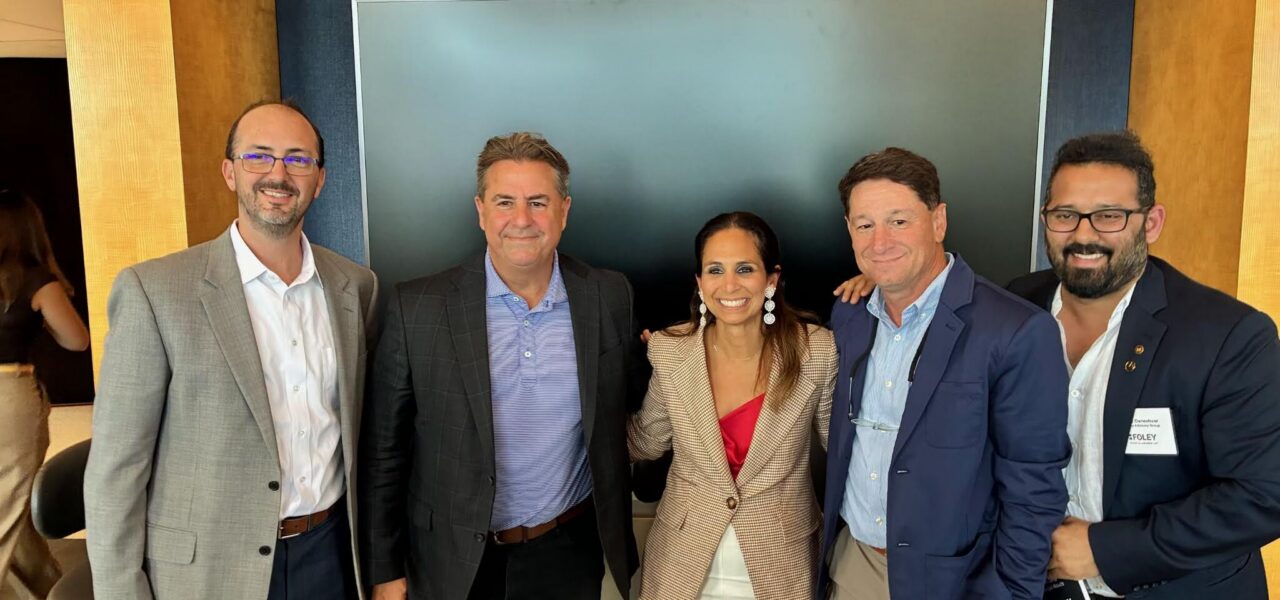
What does it take to build the next unicorn in health AI? The answer, as a panel of seasoned leaders made clear during “Blueprint for a Unicorn: The Founders Playbook for Winning in Health AI,” is less about flashy technology and more about people, culture, and execution. Moderated by David Sanders (Partner, Foley & Lardner LLP), the panel featured Chris Frew (CEO, Workforce Genetics & BioBuzz Networks), Ainsley MacLean, MD, FACR (Founder, Ainsley Advisory Group), and David Kantaros (Partner, Foley & Lardner LLP). Together, they offered a candid and practical look at what it takes to build and fund the next big health AI success story.
The Foundation of a Unicorn: Team First
The discussion opened with Sanders asking about the most critical hires for startups seeking to prove they’re “for real” in the eyes of investors. Dr. Ainsley MacLean set the tone by noting that it’s not really about titles. Too many companies, she explained, get caught up in needing a “chief this” or “chief that.” What matters most is leadership, people, and, above all, the team. In her words, nothing is more important in the startup setting than having a cohesive group that works well together and scales with the company.
Chris Frew built on that point, emphasizing that early-stage companies shouldn’t get trapped by traditional hiring models. Full-time, he argued, doesn’t need to be in a founder’s vocabulary at the start. A chief medical officer might be on retainer for a few hours a week, and an AI team might be fractional. What matters is culture. “If you do have those golden tickets for full-time hires, you have to hire for culture,” Frew explained, underscoring that technical gaps can be filled fractionally, but culture is nearly impossible to reverse once it turns negative.
Investors see the world much the same way. Kantaros recalled advice he once received from a legendary Boston venture capitalist: given the choice between A-level talent with C-level technology or A-level technology with a mediocre team, he would invest all day in the A-level team. An exceptional team can make weak technology work, but a subpar team will squander even the best idea.
Culture and Fit: The Make-or-Break Factor
The conversation repeatedly returned to culture as the defining element of startup success. Sanders was blunt: “You can draft the greatest documents in the world, but if the companies are not aligned on culture and mission, it’s going to fail. Doesn’t matter how good the match looks on paper.” MacLean echoed the sentiment, cautioning founders to never settle. If something feels off in an interview, she advised, walk away before making the wrong hire.
Frew added that cultural fit often reveals itself over time. He described how he sometimes spends months getting to know a potential hire before making an offer. When candidates begin to buy into the company’s mission on their own—volunteering to help on projects, for example—that’s a strong signal they’re the right fit. Kantaros, speaking from a legal perspective, reminded founders that prolonging a bad hire only increases risk and cost. A wrong hire punishes a company far more than leaving a position unfilled.
Building Balance: Experience Meets Hunger
An audience member asked about the right balance between seasoned veterans and hungry young talent. MacLean described the mix as the “secret sauce” behind many of the world’s best companies: pairing experience with raw, unbridled brilliance creates productive friction that pushes teams forward. She also highlighted the importance of expanding the table beyond the usual suspects. Healthcare startups, she argued, should include voices from payers, regulators, biopharma, and product development early in the process. This diversity of expertise helps companies connect the dots and navigate the industry’s complexity.
But balance is not just about skills; it is also about alignment. Frew shared the story of a client who attributed the loss of hundreds of millions of dollars to one cultural misfit in a leadership role. Technically, the person was qualified. But when sitting across from big pharma partners, the misalignment was glaring—and devastating. The takeaway was clear: no amount of talent or experience can make up for the wrong cultural fit.
AI in Healthcare: Promise and Pitfalls
With the foundation of people and culture established, Sanders shifted the conversation to AI. The promise of the technology is undeniable, but so are the pitfalls. Kantaros explained that raising capital for an AI company is not simply about proving the algorithm works. Investors will put startups through extensive due diligence, asking tough questions not just about the technology but also about regulatory pathways and reimbursement strategies. Without answers, even the most advanced model will struggle to gain traction.
MacLean noted that AI hype has created a flood of noise in the market. Health systems are often pitched by dozens of companies in a single day, many with products that appear to be spun up overnight with the help of generative AI. The lower barrier to entry, she cautioned, means differentiation comes not from building a slick demo but from proving integration, scalability, and impact. In her experience, AI is often just the “icing.” The real opportunity lies in the systems beneath it, where efficiency gains can transform operations.
Sanders added a practical reminder that success in healthcare always comes back to economics. “Who’s going to pay for it?” he asked, noting that if patients cannot afford it, companies must navigate private payers, Medicare, Medicaid, and coding. Those are not challenges solved by youthful energy alone. They require the proverbial “gray hair”—experience and gravitas to guide strategy through regulatory and reimbursement thickets.
10 Lessons for Founders: The Blueprint
The panel left the audience with a clear playbook for building enduring health AI companies. Ten core lessons emerged from the discussion:
- Invest in people before titles. Cohesion and adaptability matter more than impressive résumés.
- Hire for culture, not just skills. Misaligned hires cost more than vacancies.
- Balance the mix. Pair experienced operators with hungry innovators to create both stability and energy.
- Leverage fractional talent. Early-stage companies don’t need every role filled full-time.
- Plan for reimbursement and regulation. Algorithms alone won’t drive adoption—compliance and payment will.
- Differentiate beyond the hype. As MacLean noted, health systems are drowning in pitches, sometimes hearing “literally 20 pitches yesterday from people that have a product, which was generated by ChatGPT.” The low barrier to entry means startups must prove they can deliver real integration and impact.
- AI is the icing, not the cake. MacLean emphasized that the true value often lies in the systems beneath the AI layer. Many companies are now asking how to apply AI internally to drive cost avoidance and efficiency rather than just bolting AI onto a product.
- Plan for payment and reimbursement early. Sanders reminded founders that even the best technology fails without a path to revenue: “Who’s gonna pay for it? Because if the individuals can’t afford it, that means you’re going to private pay, you’re going to Medicare, you’re Medicaid, you’re getting coding.”
- Stay agile in a fast-moving market. Frew stressed that health AI markets move at “the speed of light,” making it essential to keep teams lean and fluid. “Six months go by and you’re like, we gotta pivot and change. And that’s just the reality we live in today.”
- Keep standards high for advisors. Kantaros warned that too many startups load up on advisors who aren’t engaged. He argued for setting expectations with cliff-vesting: “They don’t get any equity right away. They’ve got to stay involved for a little bit, so you have a chance to really feel them out.”
The Road Ahead
While unicorns are rare by definition, the insights shared by Sanders, Frew, MacLean, and Kantaros make clear that building one in health AI is less about chasing buzzwords and more about disciplined company-building. Success will belong to founders who invest deeply in their teams, cultivate resilient cultures, and ground their AI solutions in real-world healthcare value. As Frew put it, culture is so critical in the early phase of a company: being on mission, on brand, and willing to “run through that brick wall” together is what matters most.
In health AI, technology may open doors, but people walk through them. And that, ultimately, is the blueprint for a unicorn.