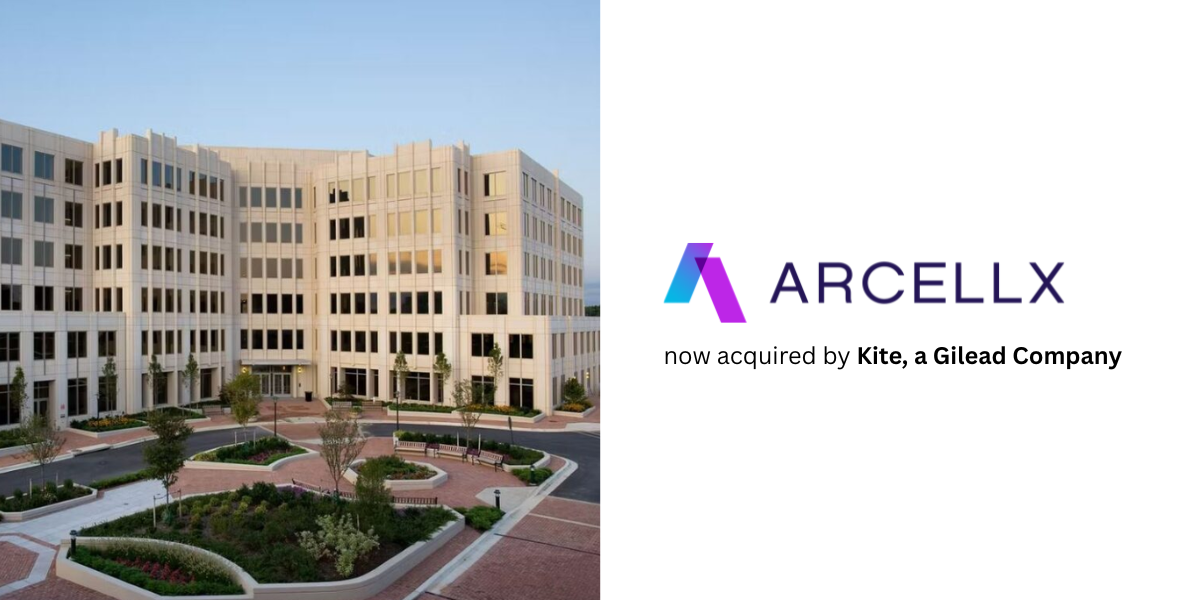
Gilead’s $7.8 billion buyout of Arcellx closed in April. The more durable return may be the operators that deal released into the BioHealth Capital Region and beyond.
When Gilead completed its acquisition of Arcellx on April 28, the coverage did what deal coverage always does. It tallied the $115-per-share cash price, the $5 contingent value right tied to $6 billion in cumulative anito-cel sales through 2029, and the December 23 FDA action date that will decide whether Kite brings Arcellx’s BCMA-directed CAR T to patients with multiple myeloma. A few weeks later came the harder number, which BioBuzz reported in May: 192 positions eliminated as Arcellx was folded into Kite, 84 of them in Rockville.
Both sets of figures are accurate, and neither captures the return I’ve been watching accumulate since. Five months after the close, Arcellx alumni are turning up as chief technical officers, CMC heads, development leaders and founders at companies across the BioHealth Capital Region and well beyond it. Each of them carries something acquisitions rarely get credit for producing: firsthand experience taking a therapy from incubator bench space through an IPO, deep into the clinic and into a big pharma deal.
I’ve come to call that return the alumni dividend. It is the part of a successful exit that almost nobody counts, and in my experience it is often the part that matters most to a regional ecosystem over the following decade.
Creative Destruction on the I-270 Corridor
I first applied Joseph Schumpeter’s idea of creative destruction to this region in March 2019, as the MedImmune brand dissolved into AstraZeneca and Novavax absorbed a painful trial setback. My argument then was that the BioHealth Capital Region had diversified enough to treat those shocks as mutation rather than decline. Institutions changed form, but the people and the know-how stayed, recombined and built again.
We saw the same dynamic in Baltimore after Edwards Lifesciences acquired Harpoon Medical, a story we told in Success Breeds Success: one exit recycled capital and entrepreneurial experience back into the city’s medtech community, and the next round of companies benefited.
The defining local case, though, is Human Genome Sciences. Founded in 1992 and acquired by GSK in 2012, HGS disappeared as an independent company. Yet when BioBuzz traced where HGS alumni went, the result read like a directory of the region’s biotech leadership, with founders, CSOs, heads of R&D and operators who went on to build the next generation of companies. GSK acquired the products and the platform, while the region kept a workforce that knew how to build the next company, and that workforce is still compounding more than a decade later.
Many of those leaders are still shaping the industry today, often in bigger roles than when BioBuzz first profiled them. Stephen Perry, now Chairman of Kymanox after 20 years as CEO, and Tom Spitznagel is senior vice president of technical operations at Bora Biologics after its acquisition of MacroGenics. Curran Simpson leads REGENXBIO as president and CEO, Rutul Shah is chief operating officer at Precigen, and Samneang Samnang is site operations director, DPF, at United Therapeutics. Arcellx is now writing the sequel.
A Hiring Bar I Saw Up Close
I should be transparent about my vantage point. Through Workforce Genetics, I served as one of Arcellx’s recruitment and executive search partners during its early growth and through its IPO, so I saw from the inside how the company decided who belonged on the team.
Founder David Hilbert set that standard from the start, and Rami Elghandour, who took the torch as chairman and CEO, carried it through the company’s public-market years. Both ran a demanding hiring process and led with clearly articulated principles. Elghandour regularly interviewed every prospective employee himself before an offer letter went out, to make sure each hire met the company’s bar for both caliber and culture fit. That discipline showed in who Arcellx attracted and who it kept. The people who made that journey are among the best operators I’ve worked with in more than 20 years in this industry.
That matters for the creative destruction argument. An acquisition only seeds an ecosystem if the people it releases are worth seeding with, and a team assembled to that bar is a rare kind of regional asset.
Where the Arcellx Alumni Are Landing
A partial roll call shows how widely the seeding already runs, and how it began well before the acquisition closed.
Kenny Choi, PhD, led process development, CMC program management and external manufacturing sciences as Arcellx’s vice president of CMC. In August, Oryon Cell Therapies named him chief technical officer, putting him in charge of moving manufacturing for Oryon’s autologous iPSC-derived dopaminergic neuron therapy for Parkinson’s disease from Mass General Brigham into the company’s own facilities. He has contributed to more than a dozen cell and gene therapy INDs and three BLAs for autologous cell therapies, which is exactly the experience a company planning for late-stage development and launch needs to hire.
Steve Rose, formerly executive director of protein sciences at Arcellx, has joined Rockville-based NovaBridge Biosciences, the Nasdaq-listed company formerly known as I-Mab, as vice president of CMC. Tuhin Bhowmik, PhD, Arcellx’s director of manufacturing, has moved to one of the region’s anchor employers as director of drug product development at AstraZeneca.
Laura Richman, MBA, PhD, DVM, DACVP, came to Arcellx after serving as vice president of translational sciences at AstraZeneca and executive director of the University of Pennsylvania’s Gene Therapy Program. She left as senior vice president of R&D to become chief development officer at Waltham, Massachusetts-based Affinia Therapeutics, and over her career has led or co-led more than 50 IND applications and three BLAs. Based in Maryland, she consults with early-stage companies through her firm, DOA Consulting, with ties to local startups and founders.
Martha Sklavos, PhD, PMP, built Arcellx’s pipeline operations function as senior director and head of pipeline operations during the company’s early growth. She went on to found Germantown-based Aloe Therapeutics, which is developing Allo-Immunotherapy (AIM), a locally delivered, cell-based therapy designed to draw immune cells into solid tumors, and which has drawn investment from TEDCO.
Tara Crnkovich, who helped build and advance quality operations as Arcellx’s head of QA operations, is now CEO of Texcell North America. Texcell is a global contract research organization specializing in viral safety testing, and Crnkovich brings a pedigree much like Richman’s, with nearly a decade at MedImmune and more than five years in AstraZeneca manufacturing sciences before Arcellx. On the finance side, former CFO Michelle Gilson, who helped carry Arcellx from Phase 1 through BLA submission, the Kite collaboration and the Gilead deal, has joined the board of Rani Therapeutics.
Four of these seven are CMC, manufacturing and quality leaders, working in the disciplines where cell therapy companies most often stall and where experience is hardest to buy. Three have stepped into the C-suite or the founder’s chair. Their destinations run from a Germantown startup and a Rockville public company to AstraZeneca, a viral safety CRO, a Silicon Valley boardroom and cell and gene therapy companies in Greater Boston, which is what an ecosystem’s talent export looks like when it is working.
The Hilbert Lineage
David Hilbert’s own career shows how this compounds across generations. He began at HGS in 1996, spending eight years guiding preclinical development of antibodies and genomics-based therapeutics, then served as vice president of research at Cellective Therapeutics, a startup MedImmune acquired in 2005, and later as CSO of Zyngenia. He then founded Arcellx, which launched out of the Germantown Innovation Center on Montgomery College’s PIC MC campus.
Along the way he has helped bring two products to commercialization, and anito-cel now sits before the FDA with a December 23 action date that could make it his third. Count careers instead of products and the numbers grow quickly. His years at HGS shaped dozens of scientists who went on to lead elsewhere in the region, and Arcellx gave a second cohort the rarer experience of carrying a cell therapy from startup to IPO to late-stage clinical execution to a $7.8 billion acquisition.
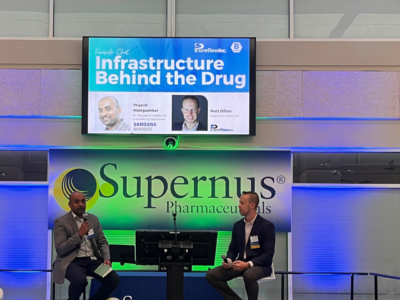
In June, at BioBuzz’s Next Helix event at PIC MC, a short drive from where Arcellx began, Hilbert traced Maryland biotech through four generations, from vaccines to cell and gene therapy, and pointed to regenerative medicine and RNA biology as the next frontiers. Many of the people best equipped to build companies in those fields just finished helping him build his last one.
That raises the question I find most exciting about this moment: who among the Arcellx alumni becomes the next David Hilbert? Hilbert took what he learned across eight years at HGS and turned it into a company that carried a cell therapy to the doorstep of FDA approval. Somewhere in this cohort is a scientist or operator who will do the same with what they learned at Arcellx, whether by founding a company, leading a new platform into the clinic or bringing the next therapy to patients who need it.
Counting the Alumni Dividend
When a regional company is acquired, the scorecard usually covers three things: the purchase price, the jobs lost and whether the buyer keeps a local footprint. Those questions matter, and the 84 Rockville positions represent real disruption for families in our community. A fuller accounting would also track where the alumni land, how many companies they found or join, how much capital follows them and how many first-time teams they mentor through problems they have already solved.
For startups across the BioHealth Capital Region, this is a rare window to bring in people who have already done the hard thing, whether as full-time executives, fractional leaders or advisors. For investors and economic developers, keeping these operators building here deserves the same urgency as recruiting the next anchor tenant. For the Arcellx alumni themselves, the region is stronger for what you built, and it has a great deal riding on what you build next.
HGS taught us that the dividend from a great company keeps paying for decades after the acquisition press release fades. BioBuzz will keep tracking where this cohort goes, and I’d welcome hearing from any Arcellx alum whose next chapter belongs in that story.