
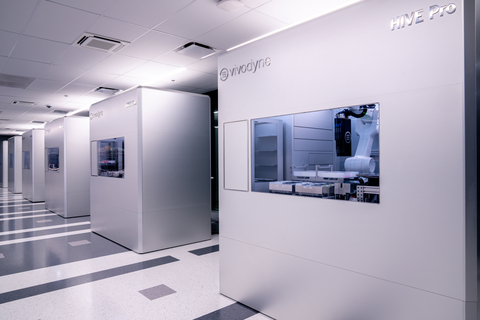
Photo credit: Vivodyne
Vivodyne, the company built out of University of Pennsylvania bioengineering research, has launched what it describes as the world’s largest human biological datacenter, a network of 12 robotic HIVE laboratories capable of running 3.1 million living human tissue experiments a year, roughly double the combined scale of every clinical trial conducted in the U.S. The announcement carries a joint San Francisco and Philadelphia dateline, reflecting where Vivodyne actually operates: its biological datacenters sit in both the Bay Area and Philadelphia.
The Technology Behind the Claim
At the center of the platform is Vivodyne’s Series 2 TissueDisk, a wafer-scale biological chip that grows hundreds of functional human tissues simultaneously, each reaching the size of a clinical biopsy with 200,000 to 500,000 cells, self-assembled blood vessels, and organ-specific function. In comparative testing, the company says its lab-grown airway tissue achieved a 96% Lin’s concordance correlation coefficient with real human patient tissue in cellular composition, with disease-specific gene expression patterns it describes as indistinguishable from those seen in actual patient samples. CEO and co-founder Andrei Georgescu framed the effort as a response to the limits of current drug development: “Superintelligence in biology is needed more than ever, because we’re running out of diseases that can be cured with the simple, single-target medicines of today. You cannot fix a car by turning a single screw, and the idea that the complex malfunctions in cancer, fibrosis, autoimmune disorders, or neurological disease can be fixed with a conventional single-target drug is wishful denial.” He went on to describe why the company is generating tissue data at this scale rather than relying on cell cultures or animal models: “Testing in cells or animals is not enough; we don’t train our language models on whale sounds. To create AI that understands our intricate human biology, we need to continuously generate and train on huge amounts of human data, and we can’t get that by risking people.”
Tony Bahinski, Ph.D., Vivodyne’s chief biotechnology officer and a long-standing member of the FDA’s science board, framed the distinction: “Computational models of human biology have largely been graded on how well they fill in data resembling information they have already seen, and that is reconstruction rather than novel prediction
Who’s Actually Using It
Vivodyne says eight major pharmaceutical companies already have early access to the platform, applying it across pulmonary tumors, biologics, cell therapies, fibrosis, inflammatory disease, and vaccine development. The pitch to those companies is straightforward: generate human-relevant safety and efficacy evidence on lab-grown tissue before a drug candidate ever reaches a clinical trial, potentially cutting down on the number of compounds that fail in humans after looking promising in mice.
From a Penn Bioengineering Lab to a Two-Coast Operation
Vivodyne’s origins trace directly to Dan Huh’s BIOLines lab in Penn Engineering’s Department of Bioengineering, where Huh developed organ-on-chip microfluidic devices, including earlier work on a placenta-on-chip and an eye-on-chip with a mechanical blinking eyelid. Georgescu co-founded the company with Huh while pursuing his Ph.D. in Huh’s lab, and the two have scaled the underlying science considerably since: from roughly $4 million raised by April 2021 to a $38 million seed round led by Khosla Ventures in November 2023. That growth has kept a real foothold in Philadelphia even as Vivodyne built out Bay Area operations, and this week’s launch keeps both cities in the company’s own description of where its technology actually lives.