The investor didn’t come for the cocktail. He came because the glass in his hand—a signature cocktail named after a startup’s “icebreaker”—made it easier to find the CEO who’d invented it. The drink wasn’t the point. The collision was. Within minutes they were talking unit economics, clinical milestones, and the first pilot customer. No panel grandstanding. No expo-hall. Just a high-intent conversation that might actually move a deal forward.
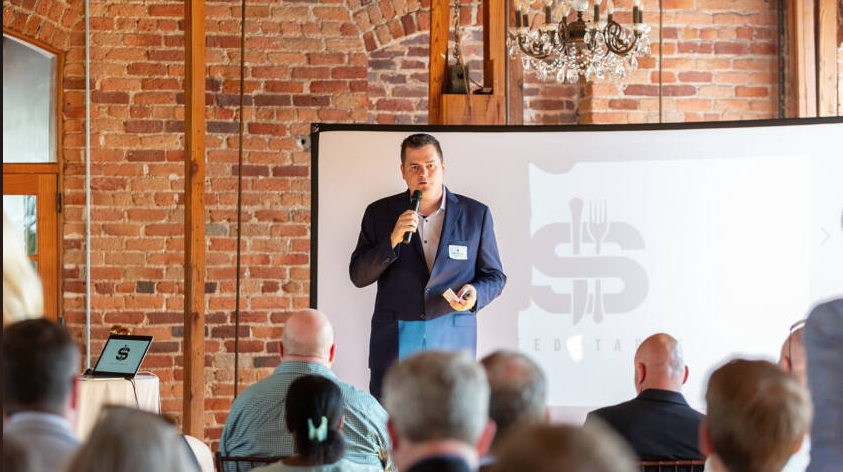
That collision is what Caleb Thornton is selling with Seed2Table, a post-pandemic series of tightly curated, in-person gatherings for founders, investors and the operators who sit between them. In a season of ever-bigger conferences, Mr. Thornton is betting that smaller rooms built around specific investment theses will produce more—and better—work for both sides of the table.
“We curate for signal, not headcount,” he says. “Ninety of the right people beats two hundred with distractions.”
Thornton sat down with Kymanox CEO and Founder, Stephen M Perry on the OrangeT Podcast (watch full podcast) to dive into Seed2Table and what makes these events stand out.
Seed2Table began the way many boutique events do: with white tablecloths and a tasting menu. It photographed beautifully and felt exclusive, until the team watched what it did to the room. Guests stayed planted. The best investors made exactly one lap. Conversations ossified along the seating chart. Mr. Thornton’s fix was unglamorous and effective—ditch the formal dinner for heavy hors d’oeuvres and long networking arcs that let people circulate two or three times in an evening.
The bigger change came on the stage. After short founder pitches, Seed2Table added reaction panels populated not by professional moderators but by working operators—an ex-eBay executive among them—who assess feasibility in plain language. The result is a kind of compressed diligence: a founder’s rebuttal under pressure, an operator’s read on whether the thing could actually work, and a room’s unguarded response, gathered in minutes instead of weeks of calls.
The model travels, but not indiscriminately. Philadelphia nights center on digital therapeutics; Boston skews toward life sciences; Washington leans into GovTech and aerospace. Miami’s program is building around crypto. The point isn’t to be everywhere—it’s to be exactly where the investors for that vertical already are, then narrow the aperture until useful collisions become hard to avoid. This fall the series goes to Atlanta (Sept. 25), Los Angeles (October) and Miami (November), with West Coast meetings picking up around the edges.
Underneath the logistics is a view of founder behavior that most investors will recognize. Early-stage CEOs, especially those running “platform” companies, are prone to presenting everything at once—the science, the adjacent markets, the inevitable empire. A $3 million raise can start to look like a $40 million scope. Mr. Thornton pushes teams to lead with one sharp product and save the sprawling “moat” for diligence. “Show me where the first dollars go,” he tells them. The room is built to reward that discipline.
It also punishes indecision. “The second-best answer is a quick ‘no,’” Mr. Thornton says. Ambiguous maybes get pressed to a decision so both sides can clear headspace and move on. He gives founders an unromantic metric to keep them moving: plan on roughly 50 meetings from pre-seed or seed to the first check. Some will close faster; many shouldn’t. Investors who prefer to watch execution over a quarter or two will recognize the pacing—and appreciate not being chased for vanity updates between events.
Curation is Seed2Table’s spine. One month out, most organizers start padding RSVPs to hit a number. Here, it’s common for 100 to 300 names to be declined to keep the mix tight. The company also tries to widen the pipeline without lowering the bar: its executive team is split evenly between women and men, every event opens with a female founder, and it has run all-female founder programs without making a marketing point of it. The payoff is practical. Investors meet strong teams they’re unlikely to see on a standard roadshow.
The rooms are designed to de-risk rounds in ways term sheets alone can’t. Alongside venture capital, Seed2Table courts buyers, labs and institutional partners—the people who can say yes to a pilot or unlock data that matters in diligence. In Washington, the group’s relationship with Georgetown University changed outcomes for multiple companies. Sponsors play an enabling role rather than a decorative one; an airline’s support, for instance, helps make the cross-hub model sustainable.
All this is more craft than spectacle. Even the much-talked-about cocktails are less a gimmick than a nudge: a founder with a glass named for their product has social proof and an opening line; an investor has an easy way to start the right five-minute conversation. If Seed2Table works, it’s because the frictions are engineered out and the incentives are aligned: founders are coached to focus; investors are given reasons to trust their own filters; both sides leave with three real next steps instead of 30 business cards.
There are plenty of places to be seen. This is a place to see clearly. Investors who want in are asked for something simple up front—their thesis and check size—so the room can be built around it. The promise isn’t that a round will close before dessert. It’s that the next meeting will be worth taking.