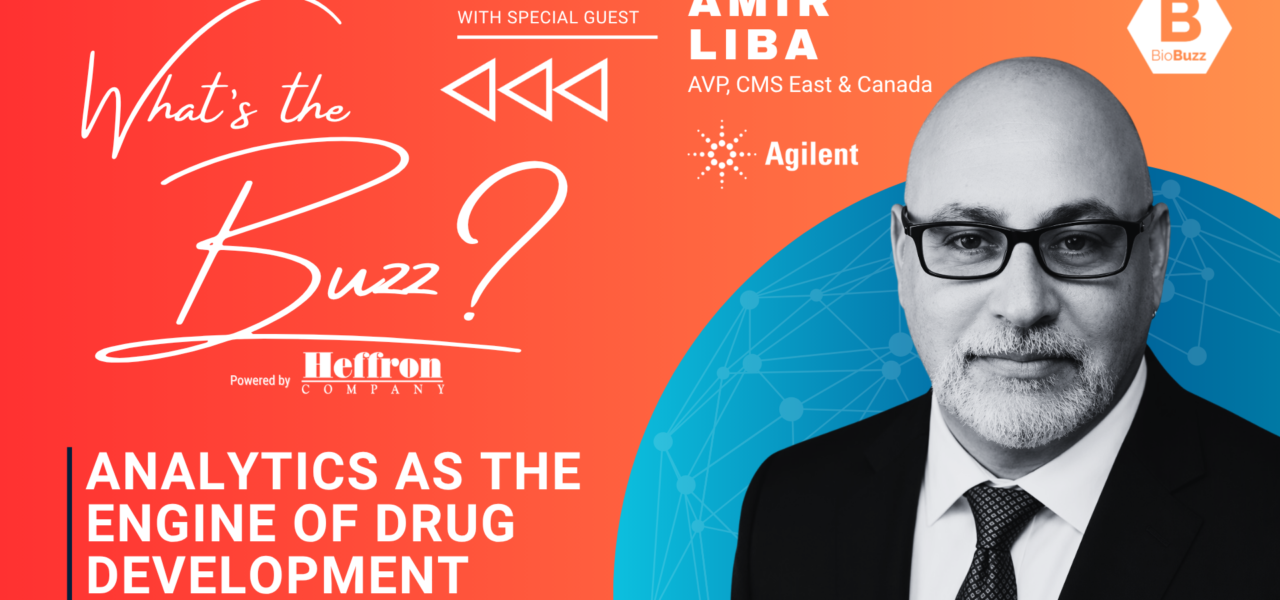
The molecule gets the headline. The method is what gets it there. In this episode, Chris Frew continues BioBuzz’s analytics-themed month with a conversation that goes straight to the engine room of drug development — the analytical methods, regulatory frameworks, and organizational decisions that determine how fast, and how safely, a therapy actually reaches the market.
In this episode of What’s the Buzz?!, Chris sits down with Amir Liba, who leads Agilent Technologies’ sales, applications, and technical specialist teams across the US and Canada, to dig into why Agilent chose Greater Philadelphia for its first Biopharma Analytical Innovation Summit, what’s really slowing programs down on the way to market, how ICH’s newer guidelines are reframing analytical methods as a lifecycle rather than a one-time deliverable, and what genuine collaboration between an instrument maker and a standards body actually looks like.
This episode of What’s the Buzz?! is powered by Heffron Co., a 104-year-old leading mechanical and engineering services firm based in Maryland and BioBuzz’s annual sponsor.
Recorded LIVE — August 6, 2026
Key Takeaways
- Why Greater Philadelphia: the summit will be held at The Desmond Hotel in Malvern, PA, in the Philadelphia suburbs — reflecting how the tri-state corridor spanning Pennsylvania, New Jersey, and Maryland has become a central hub for pharma and biopharma — not just large conglomerates, but startups, CROs, CDMOs, and incubators — anchored by strong academic institutions and research hospitals like the Children’s Hospital of Philadelphia (CHOP) that feed the local talent base.
- A customer’s-eye view: Amir traces his perspective on analytical instrumentation back to his own days as co-director of a new core lab at UCLA, staring at a newly purchased instrument with no clear sense of how to take the first step — an experience he says still shapes how he thinks about what customers actually need.
- It’s the method, not just the molecule: analytical methods sit upstream of every marketed drug, testing for efficacy, stability, and safety — critical quality attributes like resistance to oxidation can determine whether a molecule is even viable, yet they rarely make headlines the way the drug itself does.
- What actually delays time to market: Amir argues the industry largely has the technology and the talent it needs — the more common bottleneck is organizational: aligning people around what the data means and what action to take next.
- The shift to biologics is straining the analytical toolbox: as pipelines move from small synthetic molecules toward peptides, oligonucleotides, and complex biologics, questions shift from “did I synthesize the right compound?” to multidimensional challenges like product heterogeneity, variants, and manufacturing-related alterations — pushing mass spectrometry from simple confirmation toward full characterization.
- ICH Q14 and Q2(R2) are pushing the industry to treat analytical methods as a continuous lifecycle — design, qualify, monitor, and improve — rather than a one-time “develop, validate, and store” deliverable.
- Reframing the budget conversation: the most successful labs stop positioning analytical work as a cost center and instead build a business case around risk reduction, improved quality, and shorter time to market — outcomes that translate directly into wider margins and greater revenue.
- What good collaboration with regulators looks like: drawing on his own early-career work on USP’s 232/233 elemental impurities monographs, Amir outlines what makes forums between instrument makers, standards bodies, and drug developers actually productive.
Guest Bio
Amir Liba
Amir Liba leads a team of sales, applications, and technical specialists across the US and Canada for Agilent Technologies, where he has worked for more than 18 years. He joined Agilent from academia, where he served as co-director of a newly established core lab in the Department of Chemistry and Biochemistry at UCLA. After a brief stint in marketing, Amir transitioned into commercial leadership roles at Agilent over the past 12-13 years. Early in his Agilent career, he contributed analytical expertise to the development of USP’s 232 and 233 monographs on elemental impurities in drug products.
→ Connect on LinkedIn: https://www.linkedin.com/in/amir-liba-b8764a8/
About Agilent Technologies
Agilent Technologies is a global leader in analytical instrumentation, serving customers across drug discovery, drug development, and quality control laboratories. Beyond its product portfolio, Agilent maintains the Agilent Community, a platform connecting its technical specialists with customers to exchange questions, troubleshoot problems, and share ideas. This September, Agilent is hosting its inaugural Biopharma Analytical Innovation Summit at The Desmond Hotel in Malvern, PA, in the heart of the Greater Philadelphia biocluster, bringing together drug developers, regulatory bodies like USP, and analytical scientists for a day of collaborative programming.
Resources Mentioned
- Heffron Co. (episode sponsor)
- Agilent Technologies
- Biopharma Analytical Innovation Summit — Philadelphia (Malvern, PA), September 16, 2026
- Eamon Evans (prior What’s the Buzz?! guest, Agilent)
- Children’s Hospital of Philadelphia (CHOP)
- UCLA Department of Chemistry and Biochemistry
- USP (United States Pharmacopeia) — Monographs 232 and 233
- ICH (International Council for Harmonisation) — Guidelines Q14 and Q2(R2)
- U.S. Food and Drug Administration (FDA)
- AOAC INTERNATIONAL
- Agilent Community
- Conner Strong & Buckelew (teased upcoming BioBuzz event, “Convergence of Life Science and Healthcare”)
Transcript
Opening Remarks (00:00 – 03:54)
Chris: Good afternoon, everybody. This is Chris Frew with BioBuzz, welcoming you back to another episode of What’s the Buzz. Today I’m excited to feature another guest as we continue talking about analytics, our theme for the month. Amir Liba leads a team of sales, application, and technical specialists across the US and Canada for Agilent Technologies. Amir, welcome.
Amir: Thank you, Chris. Much appreciated — I appreciate the opportunity.
Chris: Today we’re going to talk about analytical science as a real engine for modern drug development. Before we jump in, let me give a shout-out to our annual sponsor, Heffron and Company. What I love about Agilent is that you’re a household name in analytical instrumentation, but a lot of people might not know you’re building community every day — a whole community of analytical scientists. That’s why we’re partnering with you, because we love how you look at the people you support as part of a community, and BioBuzz thinks the same way. Heffron is one of the top community builders we know — they’re literally building the ecosystem. They’re a leading mechanical and engineering services firm based in Maryland, and if you drive up and down the I-95 or I-270 corridor, there’s a huge chance they were the mechanical firm behind the facilities you pass. They’ve been around for 104 years, and Colin, their president and CEO, and the whole team are absolutely salt of the earth and dedicated not just to their clients but the patients they serve. Thank you, Heffron, for being our annual sponsor. Amir, can you give us a quick personal introduction and your role at Agilent?
Amir: Absolutely. I’ve been with Agilent for over 18 years and held various positions throughout. My first introduction to Agilent was straight from academia, into the application realm, so I was infused with analytical methods from the start — that’s where I really got a profound understanding of what customers want. I had a brief stint in marketing that lasted about a year and a half, then transitioned into becoming a commercial leader at Agilent, a path I’ve been on for about 12 or 13 years, which I love and adore. My team includes sales as well as applications and product specialists, and we govern sales and support of our customers across North America as a whole.
Why the Biopharma Analytical Innovation Summit Is Coming to Greater Philadelphia (03:54 – 08:20)
Chris: We talked to Eamon last week, and you all are bringing a big analytical biopharma innovation summit to Philadelphia in about a month’s time. Why are you hosting this summit, and what stood out about Philadelphia as the place to launch it?
Amir: On September 16th, Agilent is hosting the Biopharma Analytical Innovation Summit, with invited speakers discussing biopharma workflows, quality control, quality assurance, and our broader portfolio for drug development and discovery. We’ll have multiple tracks across oligos, peptides, and proteins. Why Philadelphia? I’m biased — I live about 15 minutes outside Philadelphia on the New Jersey side. But it’s really not just Philadelphia, it’s the tri-state suburbs — Maryland, New Jersey, and Pennsylvania as a whole — that have become central and essential to the development of new ground for pharma and biopharma. It’s not just the big conglomerates building facilities there — it’s the startups, CROs, CDMOs, and incubators joining in hand in hand. On top of that, Philadelphia and its suburbs house great academic institutions, strong communities, and research hospitals — take the Children’s Hospital of Philadelphia (CHOP) as an example — which provide a strong local talent base feeding these biopharmas and CROs. It’s a great ecosystem for innovation, development, and manufacturing. This summit is a chance to bring all of these entities under a single roof for a collaborative approach to drug development, drug design, and the analytical engine behind it. That’s why Philadelphia — the City of Brotherly Love — aside from my bias, of course.
Chris: I love that visual of everybody under one roof. So beyond the programming and instrumentation presentations, there’s also this opportunity for attendees to connect, collaborate, and collide across companies, academia, and industry — is that part of it too?
Amir: Absolutely, that’s paramount. Bringing all of these entities together with a collaborative mindset for a better future around drug design and development is critical, and I’m glad Agilent gets to be an enabler of that.
A View From the Buyer’s Seat: Amir’s Path to Agilent (08:20 – 12:43)
Chris: You have a great vantage point overseeing a large North America purview — what trends are you seeing from an analytical lens?
Amir: It’s interesting — a lot of what Agilent has focused on in analytical techniques requires us to look at the challenges in front of us not from a commercial perspective, but from the lens of the consumer. Let me share a bit of my journey. I started in academia as co-director of a brand-new core lab in the Department of Chemistry and Biochemistry at UCLA — that gave me an appreciation for analytical techniques as a tool to help professors, graduate students, and postdocs. Part of my role was evaluating new analytical techniques and purchasing the hardware for the core facility. I remember sitting in front of a couple of newly purchased instruments with a completely blank look on my face — literally looking at a bucket of bolts. Even after training, I didn’t know how to take the first step, and God forbid a red light came on. That feeling still resonates with me today. When Agilent hired me and gave me close interaction with customers, I realized many of them were in the same position I’d been in — that same feeling of hopelessness. Spending time with those scientists and lab consumers gave me a real appreciation for what success looks like from their side of the instrument, not mine, and that’s what I brought into my transition to commercial leadership.
Chris: That’s an amazing perspective — starting your journey as a customer and knowing those emotions firsthand clearly shapes how you approach your work.
Amir: We talked about building communities — this industry as a whole is very embracing and inclusive. Obviously there are limits — Merck can’t talk to J&J and vice versa, that’s an obvious reality — but at the foundation level, the utilization of analytical capabilities is shared across the vast majority of people involved.
It’s Not Just the Molecule — It’s the Method (13:09 – 16:59)
Chris: I cover a lot of news, and it’s always the molecule that gets the headline. But when I talk to people in the industry, it comes down to the data — the method sets the schedule and drives things. Is that a fair characterization?
Amir: It’s a fair statement, though it depends on your vantage point. Most consumers only ever see the final product containing the active pharmaceutical ingredient — very few understand the road it takes to develop or synthesize that molecule. The typical drug design workflow begins at discovery, where multiple potential molecules are identified, then moves into development, where the molecule undergoes characterization, and — if deemed safe enough — clinical trials before it becomes a consumer product. That journey takes years, a lot of money, and a lot of bright scientists. But it’s not just about the molecule — the method development upstream of that end product is what’s critically important, because analytical methods test for efficacy, stability, and safety. Take oxidation of an enzyme’s active site as an example — the three-dimensional structure changes and the enzyme becomes inactive. The same can happen to a drug: if it oxidizes, it’s rendered essentially useless. This is the same territory as the critical quality attributes Eamon and I have both talked about. So yes, the molecule gets the headlines, but overcoming the analytical challenges in drug discovery and design is equally deserving of credit — and it absolutely sets the tone for everything downstream.
What Really Controls Time to Market (16:59 – 19:50)
Chris: Where do programs actually lose time to analytics — is it a technology problem, a people problem, or organizational?
Amir: Analytics ensures testing is done accurately, data is defensible, and ultimately that products are safe — all three matter. But I don’t think it’s really about “lost time to analytics.” Technology contributes some to the problem, and so do people and the organization, but I think the industry today has access to most of the analytical platforms it needs, and specialized scientists aren’t just there to run instruments or samples — their far more important job is interpreting the data. Most often, it’s organizational decisions that cause delays — not generating the data, but aligning the people around what the data means and what actions need to be taken.
Chris: So the organization’s ability to lead, direct, and guide around the right data and tools is what matters — the people and technology are already there.
Amir: Without a doubt. We have a great set of R&D people across multiple vendors, not just us. It really comes down to an organization’s assurance that the program behind a given drug product will be appropriately positioned in the market.
The Shift to Biologics and the Strain on the Analytical Toolbox (19:50 – 22:58)
Chris: Pipelines are shifting toward peptides, oligos, and complex biologics. What does that demand of the analytical toolbox, and where is it being strained?
Amir: Small-molecule therapeutics remain absolutely critical, but over the past several years we’ve seen a deliberate shift toward large biologics — driven by the specificity biologics offer against very difficult targets, like in oncology, along with greater safety and reduced side effects. With small molecules, the main questions are: did I synthesize the right compound, and how pure is it? With biologics, the questions multiply and become more complex — product heterogeneity, the existence of variants, and possible alterations during manufacturing, oxidation being just one example. To meet these demands, the analytical workflow has become far more multidimensional. Mass spectrometry, for example, had to evolve from simply confirming a product exists to actually characterizing the biologic — which is where high-resolution, accurate mass spectrometry comes in. We’ve made real evolutionary and revolutionary strides on the instrumentation side. Where it’s strained today is really around data complexity and interpretation — which is where we need those bright individuals, the kind who’ll be in Philadelphia.
Chris: People are always at the heart of it, aren’t they?
Amir: They absolutely are.
ICH Q14, Q2(R2), and the Shift to Lifecycle Thinking (23:00 – 25:55)
Chris: Let’s talk regulatory — ICH Q14 and Q2(R2) reframe analytical procedures as a lifecycle rather than a one-time deliverable. Has the industry internalized that shift?
Amir: ICH is the International Council for Harmonisation — it looks at pharmacopeia entities across geographies, like USP, Japan’s JP, China’s, and Europe’s, and tries to harmonize guidelines across pharma and biopharma. Q14 and Q2(R2) provide a science-based and risk-based framework for analytical protocols and validation in therapeutic drug development, to ensure quality and safety. What they’re really asking the industry to do is reframe its approach to analytical method design. Traditionally, we develop a method, validate it, and store it — use and store, rinse and repeat. The mentality shift is to design the method, qualify it, monitor it as it moves, and continuously improve it. As we keep developing newer biologics and modalities, those methods will inevitably need augmentation — so we need continuous improvement through the product’s full commercial life, not just at the beginning or at market delivery. That’s why we need a lifecycle mindset rather than a validation-centric, one-and-done mindset.
Making the Business Case for Analytical Investment (25:55 – 28:46)
Chris: Doesn’t that lifecycle approach add cost? Are you seeing tension as customers compete for budget, especially with speed-to-market pressure and tighter budgets these days?
Amir: Absolutely — welcome to the family, being part of a sales organization. Every industry has budget discussions, and analytical work is no exception. What I see, both across the industry and internally at Agilent with our own business case frameworks, is that the most successful labs have stopped positioning analytical work as a cost center. Instead of saying “this will cost you X to do Y,” they reframe it as a business enabler and give upper management measurable outcomes — positioning analytical work as a driver of risk reduction and improved quality, with shorter time to market translating almost directly into wider margins and greater revenue. Successful labs lean on business cases built around shorter time to market, lower cost, lower headcount, fewer errors, and reduced compliance risk, all pointing back to wider margins and increased revenue. That’s why making the business case is so critical — and these budget discussions aren’t foreign to us; we’re part of them at every sales opportunity.
What Genuine Collaboration With Regulators Looks Like (28:46 – 32:19)
Chris: At the summit, you’ll have Agilent, USP, and regional drug developers all in the same room. What does genuinely good collaboration between an instrument maker and a standards body actually look like?
Amir: I have firsthand experience with this. Early in my Agilent career, I was involved in providing analytical opinions and expertise for the early development of USP monographs 232 and 233, which set testing procedures and limits for elemental impurities in drug products. I remember one of our earliest meetings, invited by the FDA, sitting in a large room with people far brighter than me providing opinions — and around the periphery of the room were people just sitting there saying nothing. I asked a colleague who they were, and he said, “those are the lobbyists” — so rest assured biopharma was there in full force. But genuinely good collaboration comes down to a few things: come prepared for open dialogue with no preconceptions; have a meaningful, collaborative agenda with set goals and outcomes, grounded in understanding what’s analytically possible, what drug efficacy is being targeted, and consumer safety as a must; and set aside who “wins” — the greatest value comes from a more reliable set of results. Lowering risk and being able to defend combined decisions is why these forums matter — they nurture collaboration and help prevent future breakdowns. We collaborate this way with AOAC, US Pharmacopeia, and various other bodies, and it’s absolutely necessary.
Chris: That’s a good precursor for what to expect at the summit — that’s the environment you’re fostering there.
Amir: Absolutely.
Where Innovation Actually Comes From (32:20 – 34:40)
Chris: Agilent has released several new instruments this year. Where does that innovation come from — vendor R&D, customer problems, the regulatory environment, or all three?
Amir: It’s a well-rounded mix of all three, but if I put it in a hierarchy: we think about innovation as making things better through creativity. It typically starts with a problem — usually a customer or consumer problem. We take that to our R&D colleagues, who first check technical feasibility: can we address this now, does it need to be developed, do we have access to what’s needed? Then it goes to regulatory bodies, who determine adoption once they recognize the value. So the spark is the customer challenge, R&D develops the solution, and regulatory recognition drives adoption — which is one reason Agilent collaborates so closely with regulatory bodies as a vendor.
Chris: That’s a great pipeline perspective, grounded in the customer at every step.
Amir: Absolutely.
Closing Remarks (34:40 – 40:33)
Chris: This has been great, Amir — a couple of my takeaways: people are at the center of everything. You started in the buyer’s seat, and we’ve talked a lot about how the technology is there, but it’s the decisions people make and the experts who analyze the data that matter most. I’m biased since BioBuzz is a community platform, but that’s my read on today’s conversation.
Amir: Absolutely — and I don’t think it’s just BioBuzz, it’s the community as a whole, the people within it. Agilent has something called the Agilent Community — a field of both technical individuals and customers who want to join, almost like a bulletin board where we throw questions to one another and solve problems together. It’s a great platform. Without communities, without all of us coming together, we’d be in a very different place than we are today.
Chris: If there’s one thing you’d want a QC director or analytical development scientist to walk away with from September 16th, what would it be?
Amir: I’d want QA/QC and others to know that Agilent is a trusted partner, invested in providing innovative products and solutions to analytical laboratories across all markets — not just drug development, biopharma, and pharma, but QA/QC labs as well. The more we bring these people together through forums like this, the better we’ll all be.
Chris: So this is a one-day event on the calendar, but it sounds like a stop on a longer journey — a continuum, not a one-off, whether people already know Agilent or are just starting a new relationship.
Amir: Exactly — this is where we start forging relationships and collaborations that hopefully last. It’s where we find new people and new thought leaders. It’s going to be a great event.
Chris: Amir, thank you so much for carving out time today — any closing thoughts?
Amir: It was an absolute delight, I really appreciate the opportunity.
Chris: And I’m glad you don’t have a far drive on the 16th.
Amir: No, I don’t — and the 16th happens to be my son’s birthday, so I’ll just be driving right across the river.
Chris: That’s great, easy to do. To everyone who tuned in, thank you for trusting BioBuzz as a partner in bringing you leaders like Amir and Agilent who are forging community and helping the industry move forward. A bit of foreshadowing: August is a working month for us, but our events are on a bit of a holiday. September is coming out hot, though — we’ve got the Agilent event on the 16th, and our partners at Conner Strong & Buckelew, right across the river in New Jersey with the best view of Philadelphia looking down into the city, will be hosting a great event on the convergence of life science and healthcare, moving patient medicine forward, with some excellent speakers on the role healthcare systems play in collaborating with pharma and biopharma. Conner Strong & Buckelew is one of the leading risk management and benefits providers in the life science industry, with a specialized practice — brokers who actually know the industry and can spell PCR and tell you the difference between a Phase 1 trial and basic research. Please check out our events calendar. That’s the next big event outside the summit. Until then, we’ll be back in a couple weeks with the next What’s the Buzz. Amir, this isn’t goodbye — see you in a couple weeks.
Amir: Absolutely, without a doubt.
Chris: Thank you all, enjoy the rest of your day. Bye.
About What’s the Buzz?!
What’s the Buzz?! is BioBuzz’s interview series spotlighting the ecosystem builders, executives, investors, and subject-matter experts shaping the future of life sciences. Hosted by Chris Frew, CEO of BioBuzz Networks, and powered by Heffron Co., the series features candid, one-on-one conversations exploring industry trends, workforce development, commercialization pathways, and the people and partnerships driving the sector forward.
🔔 Subscribe for more conversations with the leaders, innovators, investors, and ecosystem builders driving the future of life sciences.
→ YouTube: https://www.youtube.com/@BioBuzz
→ LinkedIn: https://www.linkedin.com/company/biobuzz/
→ Website & Newsletter: /contact/