At a full-day technical summit in Malvern, analytical scientists from global pharma and Philadelphia startups focused on the work that turns complex modalities into products that can be measured, transferred, and made.
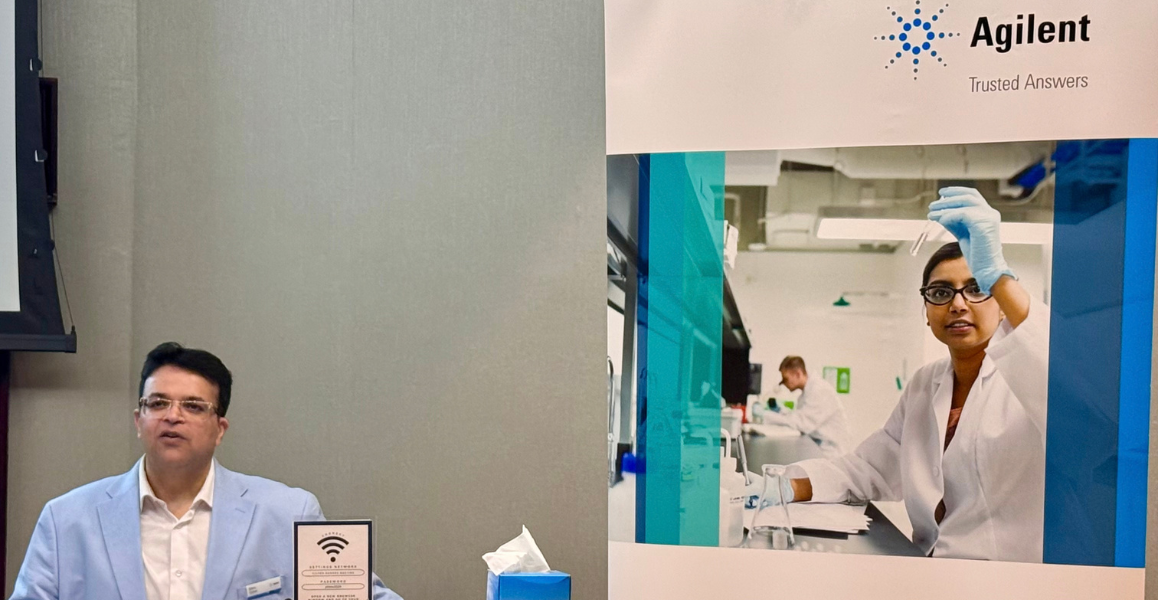
Most of industry’s attention on GLP-1 agonists and gene therapies goes to discovery, clinical readouts, and the race to meet patient demand. Less goes to the analytical work in between. That work determines whether a molecule can be characterized precisely, whether its methods hold up when they move from a development lab into quality control, and whether it can be manufactured consistently at scale. That middle ground was the subject of the Biopharma Analytical Innovation Summit 2026, powered by Agilent, held September 16 at The Desmond Hotel in Malvern.
The summit drew nearly 100 attendees. They came from large pharmaceutical companies including Johnson & Johnson and Merck, and from Philadelphia startups such as Dispatch Bio. Experts from the United States Pharmacopeia (USP) took part throughout the day. As outlined in BioBuzz’s preview of the event, the program opened with an address from USP on compendial rigor and analytical standards. A plenary block on new Agilent technologies followed, and attendees then split into parallel tracks for peptide therapeutics, oligonucleotides and mRNA, and protein and antibody therapeutics.
Across the sessions, speakers kept returning to the three requirements the organizers had put at the center of the day. A therapy has to be measurable, its methods have to be transferable, and the product has to be manufacturable.
Measurable: Sensitivity When Sample Is Scarce
For cell and gene therapy developers, the analytical problem often starts with how little material there is to work with. In the plenary session, Agilent’s Russell Burge described adeno-associated virus (AAV) programs where R&D teams face limited sample volumes and low titers, often too low for conventional UV detection to register a usable signal. AAV capsids are also enormous as proteins go, and their critical quality attributes include aggregation and the ratio of empty to full capsids.
Burge presented side-by-side data comparing an established fluorescence detector with Agilent’s new one. The newer detector resolved aggregate profiles that the older instrument missed, and it distinguished empty from full capsids even at small proportions. He noted that aggregation behavior varies by serotype, so results for one AAV may not carry over to another. That caveat is relevant to Greater Philadelphia, where much of the cell and gene therapy base works across multiple serotypes and programs.
The peptide track showed the same push toward sensitivity from a different direction. Tom Walker, an LC-MS application scientist based at Agilent’s Lexington, Massachusetts site, presented work led by colleague Xi Chu. The team quantified semaglutide and tirzepatide at trace levels in human plasma, using automated sample cleanup before triple quadrupole analysis. Measuring at those levels matters as GLP-1 programs expand and as sponsors track lower-dose and next-generation analogs.
Transferable: Methods That Travel
Moving a method from a development lab into a QC environment was a recurring concern. Walker described a tiered approach using liraglutide samples that had been stressed in two ways: left at room temperature for several days, and forcibly oxidized with hydrogen peroxide. In the room-temperature samples, oxidation products began appearing within days. The team screened for impurities first on a compact single quadrupole mass spectrometer. They then sent only the flagged species to a high-resolution Q-TOF instrument, where electron capture dissociation pinpointed where on the peptide the oxidation had occurred. That fragmentation technique can also distinguish isobaric residues such as leucine and isoleucine.
In the peptide track’s opening session, Bill Long addressed a practical obstacle to method transfer. Long spent roughly two decades in Agilent’s columns group and earned his PhD at Virginia Commonwealth University. GLP-1 analogs can be difficult to dissolve and often require strong solvents, and those solvents distort chromatography when injected in larger volumes. The usual workarounds include diluting samples, cutting injection volumes, or adding tubing between the injector and column. Each one costs sensitivity or requires manual changes to the system that make a method harder to transfer. Long presented a feed-injection approach that dilutes the sample as it enters the flow path. It supports larger injection volumes and lets labs keep running existing methods without modifying hardware.
Compatibility came up in the plenary as well. Burge noted that the new detector works within Waters Empower, the chromatography data system many regulated labs already run. He also cautioned that labs moving methods from older detectors should re-evaluate them for method qualification rather than assume equivalence.
Manufacturable: Impurities, Stability, and Time
Long framed peptides as molecules that sit between small molecules and biologics. The GLP-1s under discussion are relatively large peptides built from dozens of amino acids. Depending on whether they are made synthetically or recombinantly, they can carry product-related, process-related, and storage-related impurities, including deamidation, oxidation, isomerization, and aggregation. For manufacturers, each of these has to be detected, identified, and reported.
Several speakers treated automation as a way to take routine burden off the bench. Walker described instruments that run check tunes and auto-tunes on a schedule, load worklists at startup, and generate customized reports. Burge recalled that an established glycan analysis workflow once took weeks when he worked in industry. Current workflows complete it in a fraction of that time, with considerably greater sensitivity.
The Conversation in the Room
The technical program was also a working conversation among practitioners. During Long’s session, one attendee drew on graduate school experience to question the cost-efficiency of polymeric columns. The exchange moved into how trifluoroacetic acid suppresses mass spectrometry signal and how to balance it: low concentrations, added acids, or a switch to difluoroacetic acid. Long called it an optimization problem, which described much of the day.
The sessions also carried institutional memory. Long traced modern pharmaceutical column chemistry to Jack Kirkland’s ultra-pure silica work at DuPont in the late 1980s. He described some everyday practices, such as priming a column with sample before analysis, as part of the craft of being a scientist. Moderator Edward Kim observed that GLP-1s have become the topic analytical teams raise wherever he travels. He encouraged attendees to keep asking questions, and they did.
Between sessions and through the closing reception, attendees connected with peers across company sizes and with USP experts. Those relationships matter in a region where analytical scientists move between sponsors, startups, and contract manufacturers throughout their careers.
What Comes Next
The instruments on display in Malvern are advancing quickly. The modalities they serve are advancing just as fast. For Greater Philadelphia, where cell and gene therapy developers, peptide programs, and contract manufacturers all compete for the same analytical expertise, the pace of the pipeline will depend increasingly on the scientists who carry methods from development into QC. How well the region develops and connects that community may shape how quickly its next generation of therapies reaches patients.
For more about Agilent and how they can support your analytical needs, check out their biopharma solutions.