Innovation districts, when done right, have created incredible economic impact across the country, but many still struggle with the same challenge: creating actual ecosystems instead of collections of buildings.
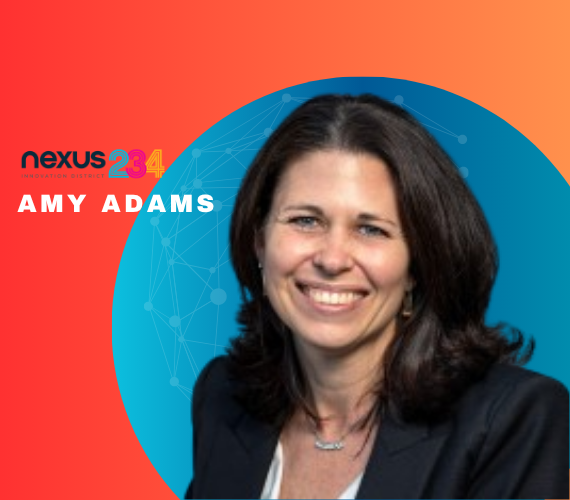
That’s the distinction Amy Adams wants people to understand about Nexus234.
“We really are building a community,” Adams said during a recent episode of What’s the Buzz? by BioBuzz. “It’s those water cooler conversations that happen when you bring people together that drive innovation.”
As Executive Director of the Institute for Biohealth Innovation at George Mason University, Adams sits at the intersection of academia, workforce development, economic growth, and startup infrastructure. But increasingly, she is also helping shape one of Virginia’s most ambitious regional innovation initiatives: Nexus234, a 6,000-acre innovation district spanning George Mason University’s SciTech Campus, the City of Manassas, and Prince William County.
While the district includes many of the physical ingredients expected in a modern innovation hub — incubator space, manufacturing capacity, research assets, startup support, and corporate partners — Adams argues its real differentiator is the partnership model behind it.
According to the March 2026 report by Real FDI (published by Real Asset Insight), the Nexus234 Innovation District in Northern Virginia has been named one of the top 10 most investable life science projects globally.
An Innovation District Built Through Regional Alignment
This story is really about what happens when institutions stop competing and start building together.
Nexus234 was not created by a single university, municipality, or developer. Instead, it emerged through a close collaboration between George Mason University, the City of Manassas, Prince William County, Northern Virginia Community College, regional businesses, and state-level economic development partners.
That alignment shaped both the district’s identity and its strategy.
“The sectors in Nexus really reflect the strengths of the region,” Adams explained, noting that the district’s focus areas — life sciences, forensic science, aerospace and defense, semiconductors and electronics, and data centers and AI — were selected based on existing industry presence, university research strengths, workforce demand, and regional economic priorities.
The name itself reflects that collaborative foundation.
“The multiple partners that came together for this — from the county, the city, the university, our local businesses, and the community college — have been very close collaborators, inspiring the name Nexus,” Adams said.
That collaborative approach is increasingly becoming essential in modern economic development, particularly as regions compete for biotech investment, advanced manufacturing projects, and highly specialized talent.
Infrastructure Is Only Part of the Equation
Across the life sciences industry, innovation districts and research parks have become a popular economic development strategy. But many struggle to evolve beyond physical infrastructure.
Adams believes the future belongs to districts that create connectivity, not just capacity.
“When businesses choose to locate somewhere, it goes far beyond the infrastructure,” she said. “You want to be part of a community. You want to connect with peers — not just peers in your lane, but peers from across different areas.”
That philosophy shapes nearly every aspect of Nexus234’s programming.
The district recently launched the Northern Virginia International Soft Landing Accelerator in collaboration with the Northern Virginia Alliance for Growth and Entrepreneurship (NALGEN), attracting companies from around the world interested in entering the U.S. market through Northern Virginia.
At the same time, workforce programs developed with industry partners are helping students gain direct exposure to biotechnology, nanofabrication, regulatory environments, and advanced manufacturing systems.
George Mason faculty and mentors are also helping smaller companies access commercialization pathways that might otherwise remain out of reach.
One example Adams highlighted involved engineering capstone students paired with local companies through a GO Virginia-supported initiative.
“These are future companies,” Adams said of the student projects. “As soon as I met with them, I said, ‘You’ve got to submit an invention disclosure.’”
The Convergence Strategy
Perhaps the most ambitious aspect of Nexus234 is its intentional convergence model.
Rather than organizing around a single industry vertical, the district was designed to bring multiple advanced industries into close proximity — life sciences alongside AI, semiconductors, aerospace, defense technologies, and data analytics.
The goal is to accelerate the kinds of interdisciplinary collisions increasingly driving modern innovation.
One example Adams shared involved George Mason researchers using nanofabrication capabilities to develop disease-detecting sensors and microfluidic systems. Another involved companies applying defense-oriented data analytics capabilities into life sciences applications.
“When you bring really smart people together, it’s going to drive new opportunity,” she said.
That convergence strategy reflects a broader shift happening nationally as traditional industry boundaries continue to blur. Biotechnology companies increasingly rely on AI infrastructure. Semiconductor technologies support medical devices and diagnostics. Advanced manufacturing capabilities now underpin national security and healthcare alike.
Innovation ecosystems that can support those intersections may gain an increasingly important competitive advantage.
Why Workforce Still Matters Most
Even with sophisticated facilities and growing investor attention, Adams says the biggest issue facing the region remains workforce development.
That concern is echoed across nearly every major life sciences hub in the country.
“The workforce component has been consistent among large businesses,” Adams noted. “Making sure they can leverage this to attract talent.”
The BioHealth Capital Region has long benefited from strong retention rates compared to larger hubs like Boston or San Francisco. Adams pointed to George Mason’s 85% regional retention rate for graduates as a major strategic advantage for Northern Virginia employers.
But Nexus234 is attempting to move beyond traditional workforce pipelines.
The district’s programs increasingly focus on continuous learning, industry-informed training, mentorship, and experiential education designed to connect students and professionals directly with employers and innovation challenges.
Importantly, Adams sees this as a community-wide responsibility rather than an institutional one.
“It really does take a community,” she said. “Businesses don’t care about boundary lines. They need a workforce. They need a supportive community.”
A New Model for Regional Ecosystems
Nexus234 arrives at a time when regions across the country are reassessing how innovation ecosystems are built.
The post-pandemic economy, federal investments in domestic manufacturing, the CHIPS Act, advanced therapies growth, and rising geopolitical competition have all increased pressure on regions to create durable innovation infrastructure.
But increasingly, the most successful ecosystems may not be the ones with the biggest campuses or newest buildings.
They may be the ones capable of aligning institutions, workforce systems, capital, research assets, and community stakeholders into a functioning network.
That is the larger signal emerging from Nexus234.
The district is still early in its development, but its partnership-driven approach reflects a broader realization spreading across economic development circles: ecosystems cannot be manufactured through real estate alone.
They have to be built through relationships.
And in Northern Virginia, those relationships may ultimately become the region’s most valuable infrastructure asset.