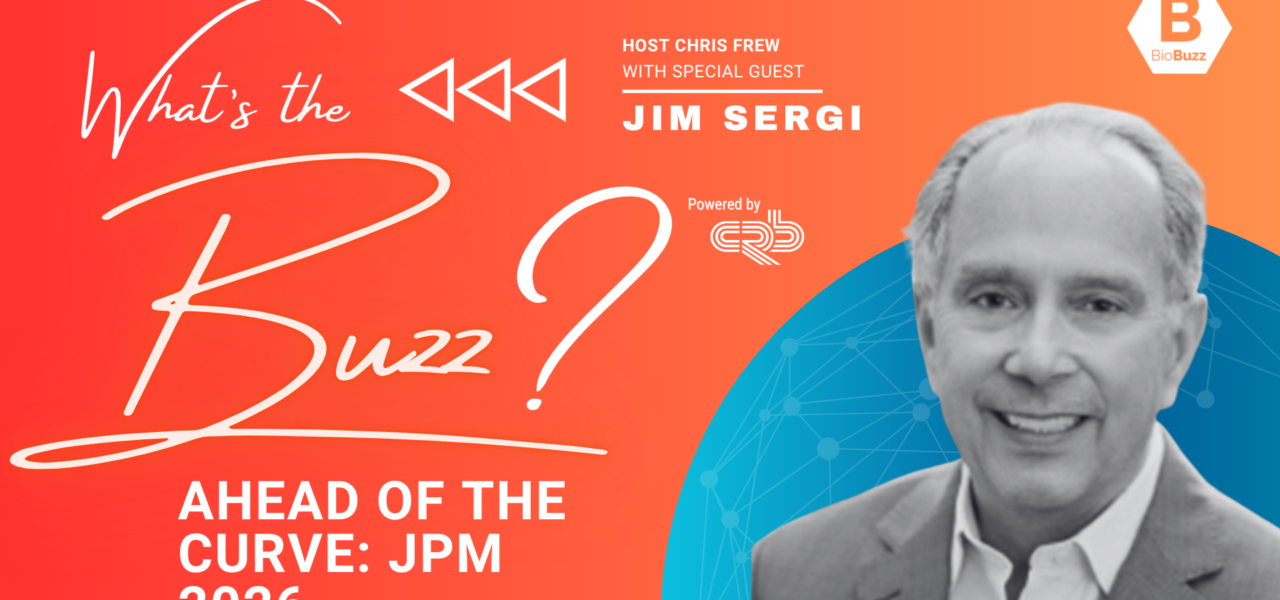
Every January, the life sciences industry descends on San Francisco for one of the most consequential weeks on the calendar—the J.P. Morgan Healthcare Conference. But JPM isn’t a single event; it’s an ecosystem of more than 30 programs, partnering forums, and side conferences that together shape the deals, funding, and partnerships that drive the industry forward for the rest of the year.
In this episode of What’s the Buzz?!, BioBuzz CEO Chris Frew sits down with Jim Sergi, President and Founder of QNOVA Life Sciences, to talk about staying ahead of the curve heading into JPM 2026. Now in its 12th year, Sergi’s partnering forum at JPM has grown into one of the preeminent gathering points for emerging biopharma and medtech companies during conference week. The conversation covers what makes JPM unique, how investor sentiment is shifting, the growing role of AI in deal-making and regulatory submissions, and what early-stage companies need to do to make the most of their time in San Francisco.
This episode of What’s the Buzz?! is powered by CRB, the architects, engineers, and builders behind many of the life sciences facilities that make innovation possible.
Recorded LIVE — November 4, 2025
Key Takeaways
- Learn how QNOVA Life Sciences built its JPM partnering forum into a 1,500-company program over 12 years, and why curated, warm introductions matter more than headcount.
- Understand why investor sentiment has shifted, with VC funding in life sciences at its lowest volume in a decade even as well-prepared companies continue closing deals.
- Discover practical advice for first-time JPM attendees, from elevator pitches and slide counts to the importance of same-day follow-up.
- See how FDA deregulation efforts, faster approval pathways, and changes to the priority review voucher program are reshaping company strategy.
- Explore the growing—and still uneven—role of AI in regulatory submissions, drug discovery, and medtech deal flow.
- Find out why emtech’s dual-use investment focus and international participation from more than 30 countries add unique dimensions to the forum.
Guest Bio
Jim Sergi
Jim Sergi is President and Founder of QNOVA Life Sciences, a regulatory consulting firm supporting emerging and growth-stage biopharma and medtech companies. With more than three decades in the life sciences sector, Sergey and his team have spent over a decade helping clients advance novel technologies through the FDA while managing time, cost, and risk. He is also the founder of one of the longest-running independent partnering forums held during the J.P. Morgan Healthcare Conference week, now in its 12th year.
About QNOVA Life Sciences
QNOVA Life Sciences is a regulatory consulting group that works with emerging and growth-stage companies across biopharma and medtech to accelerate research discoveries through to commercialization. The firm helps clients build sound regulatory and commercial development plans, manage life cycle strategy for their assets, and navigate FDA pathways efficiently. QNOVA also hosts an annual partnering forum during the J.P. Morgan Healthcare Conference, connecting companies with strategics, investors, and global trade and accelerator organizations.
Resources Mentioned
- J.P. Morgan Healthcare Conference
- emtech
- National Institutes of Health (NIH)
- Department of War (formerly Department of Defense)
- U.S. Food and Drug Administration (FDA)
- Carta
- Silicon Valley Bank
- Stifel
Transcript
Opening Remarks (00:00 – 02:00)
Chris: Good afternoon, everybody. Chris Frew with BioBuzz here for another episode of What’s the Buzz?, our opportunity to talk to what we call ecosystem builders. We use that term pretty broadly here because there are a lot of people committed to building the ecosystems that life sciences thrive in. Today I had the honor of talking to Jim Sergi, who is President and Founder of QNOVA Life Sciences. Jim, welcome to the program today.
Jim: Thank you, Chris.
Chris: I appreciate you carving off time this afternoon to talk with me. I’m excited about our conversation today on staying ahead of the curve of the J.P. Morgan Annual Healthcare Conference, which is really coming up fast, isn’t it?
Jim: It’s right around the corner.
Chris: Before we jump in, for those of you joining us for the first time today, my name is Chris Frew with BioBuzz. We’re on a mission to build the world’s largest connected community of life science professionals, one ecosystem at a time. Our interview series is an opportunity to talk to the people behind the scenes—and sometimes in front of the scenes—who are building those ecosystems and helping companies grow. As always, I want to thank our sponsor for today’s program, CRB. If you don’t know CRB, they are the builders, architects, and designers literally building the ecosystem we all work in. It’s very relevant that they sponsor this program, because they’re the true ecosystem builders behind the physical buildings where we develop innovative therapies, medicines, and devices. Special thanks to our good friends at CRB—if you’re looking for a lab buildout or expanding your facility, I can’t think of anybody better, and I’ve known them for close to two decades now.
Jim, why don’t you start us off and give us an introduction—tell us a little about yourself and your firm.
Building QNOVA and the JPM Partnering Forum (02:00 – 06:11)
Jim: Thank you, Chris. I’m the Founder and President of QNOVA Life Sciences. We’re a regulatory consultant group working with emerging and growth companies on both the biopharma and medtech sides, helping accelerate research discoveries through to commercialization in a manner that mitigates time, cost, and risk. The QNOVA team has amassed over a decade of experience helping advance novel technologies through the FDA, and we’ve also worked to support our clients in growing their businesses in a manner that is meaningful to them. We’re excited to be part of BioBuzz and look forward to welcoming everyone at JPM 2026.
Chris: I mentioned earlier that ecosystem builders take many forms. You run a consulting firm that supports a lot of different companies, but you also take a larger role in this industry—every year you host a forum at JP Morgan. This is your 12th year doing it, is that right?
Jim: That’s right. We started the partnering forum at JP Morgan 12 years ago, and it was really intended to serve as a forum to bring companies together and leverage our ecosystem and the relationships we’ve established with strategics as well as the investment community—spanning from early-stage family offices to venture capital to larger private equity and strategic financial institutions. I’ve been able to develop those relationships over 30 years in the life science sector. We started small, with just a handful of clients and meetings that first year. Since then, the program has grown into one of the preeminent programs offered during JP Morgan. As you know, Chris, JP Morgan is really a collection of programs—an ecosystem of over 30 different programs that take place in January, bringing life science companies together to discuss their novel technologies and seek partnering or investment opportunities.
Chris: It’s a really unique week, almost an ecosystem in itself, which I find fascinating.
The Scale and Reach of the Forum (06:11 – 08:41)
Jim: As a community guy, it’s an amazing conference, especially for companies attending for the first time. I like to tell them it’s unlike any other conference they’ll attend. In some regards it’s still very traditional—the dress is relatively formal, and you’re meeting people rapidly. It’s like speed dating on steroids. While it’s a very energizing time of year, it can also be very pivotal in the life cycle of a company, so planning early is a must. We’re very pleased—after 12 years, we’re in a continual state of planning and developing our program, trying to enhance it each year based on lessons learned from the previous one. We’re fortunate to have a broad ecosystem of sponsors and partners, and we’re excited to have emtech as our co-host for this event.
Chris: That’s great. You mentioned around 1,500 companies came through the event last year, and it seems to have a really specific focus. emtech sounds like a great partner that brings a unique element to it as well.
Jim: We’re very proud of the relationships we’ve built over the years and the trust we’ve earned from our partners. We have emtech participating in our program, but we’ve also had the NIH, the Department of War, and the FDA participate. What’s unique is that we bring companies and partners together to interact over the course of a week. In addition to the 1,500 companies that participated last year, we had over 30 different government trade organizations participate—that’s significant because they bring their portfolio companies to the forum, adding an international flavor and dynamic. We also had over 50 academic accelerators and incubators participate, with representation from over 34 countries last year. This year, in addition to the partnering forum, we’ve organized a plenary program featuring industry leaders discussing the latest trends, investments, and strategic partnering they’re experiencing. We’re also hosting a workshop on Monday led by the Australian government, and emtech will host a workshop on Thursday designed to help early-stage companies succeed.
Chris: emtech’s focus is dual-use, is that right—tied to the Department of War?
Jim: emtech is an invaluable resource for early-stage and emerging life science companies in both biopharma and medtech. They provide consultation and guidance, and they’re also able to make investments into companies whose technology has a dual-use purpose—civilian as well as military applications for the war fighter.
Chris: That’s fantastic, especially in this market—one of the few areas that hasn’t seen as much of a decline as others. Jim, what is it that you hear from companies that attend your events that really stands out—what keeps people coming back?
What Makes the Program Work (09:55 – 12:10)
Jim: That’s a great question. The easiest way to answer it is that we take great care in managing the introductions at the program. We do provide clients a partnering app similar to other programs companies may have used in the past, but our program has remained free of cost to companies to participate. Beyond partnering, we have a large network of thousands of investors and strategics that companies have access to. I’d venture to say more than 50% of the meetings companies have at our program happen serendipitously, on-site, because our staff understands who the investors and strategics are and provides personal, warm introductions. For small companies, the event can be overwhelming, so we work closely with companies to make sure they’re not deer in headlights and can achieve a successful outcome.
Chris: I’ve heard from a lot of first-time attendees that it can be overwhelming, so having someone like you create those purposeful introductions says a lot about your culture. Every interaction I’ve had with your team has been very purposeful and curated. Maybe we could turn to advice—do you have thoughts for people coming to JP Morgan for the first time, or rethinking their approach this year?
Advice for First-Time and Returning Attendees (12:11 – 16:37)
Jim: That gets to investor sentiment right now—understanding what’s trending and what investors are looking for, whether you’re a seed company raising your first round or a more mature company raising a Series B, C, or planning an IPO. It’s a difficult environment right now, especially amid regulatory and geopolitical turmoil. If you look at VC funding in life sciences, it’s at the lowest volume in 10 years. But companies continue to get funded—those with a sound, well-defined, well-budgeted regulatory and commercial development plan, and a clear life cycle management strategy for their assets, are doing much better than early-stage companies that remain unclear. Investors are really betting on the team. So building a tight pitch deck and elevator pitch matters most, because investors at JP Morgan typically have hundreds of meetings scheduled and are running from venue to venue. They want a clear pitch in three or four sentences. Business cards matter, and taking notes on the back of them to remember follow-up activities is important. The other critical piece is really knowing your audience—filtering carefully so your investment thesis aligns with the stage of investor you’re talking to.
Chris: I like that approach—quality over quantity. There’s a tremendous number of people there, so guarding your time and knowing where to spend it matters.
Jim: Some first-time companies go in with too many slides. If you have the opportunity to make an investor presentation, it should be no more than 10 slides, and the title of each slide needs to convey the take-home message. We spend a lot of time working with clients beforehand to make sure their presentation is tight, conveys a clear message, and includes the appropriate ask. Follow-up is critical—waiting until you get home is often too late. There are a lot of parties and events at JP Morgan, but I’ve never seen a company get funded at a party. Guard and value your time accordingly, and follow up with your investors.
Chris: Great advice. There are statistics showing that responding within the first few minutes of an inquiry matters for digital businesses too—it’s the same theme: show urgency, follow up, show you’re on top of your business.
Jim: And presentation matters in how you present yourself, because investors are watching that closely. We’re now in the age of AI, which is really driving health tech across medical technologies, and it’s important for people coming out of that space to understand that traditional life science investors are pretty old school—jeans and a t-shirt isn’t appropriate attire for this conference.
Chris: The tech-bro culture hasn’t made its way over here yet—hopefully we resist a little longer. On that note, Jim, what trends are you seeing in the marketplace and in deal-making as we head into this deal-making season?
Market Trends in Biopharma and Medtech (18:06 – 21:17)
Jim: If you break it into pharma and health tech, that’s a useful way to look at it. Investment in biopharma is down in some regards in 2025—if you look at market reports from Silicon Valley Bank, Stifel, and other analysts, funding is at its lowest point since 2015. However, there’s strong M&A activity occurring right now, across both small molecules and biologics, particularly for companies with strong science and a clear pathway to the next value inflection. It’s about pairing strong science with strong financial metrics. Deals are getting done, but on both the seed and Series A side, it’s taking longer to close. Reports from Carta show it took 24 months to close some Series A and Series B funding this past year—a long time horizon. With Series A specifically, the average reported time is six to 12 months.
On the device and health tech side, AI has really driven a lot of the deals. In 2025, 50% of deals reported by Carta and other agencies involved some element of AI integrated into medtech—particularly in neuromodulation, AI-enabled robotic surgical tools, and AI-enabled workflow tools for medical device technologies.
FDA Changes and Regulatory Pressure (21:17 – 23:42)
Jim: The other trend we’re seeing involves changes occurring at the FDA under the current administration. The FDA is expected to continue issuing new guidances and policies on how emerging technologies, as well as existing drugs and medical devices, will be regulated. We’re seeing both official and unofficial statements indicating the agency wants to look at strategies to deregulate or minimize some existing regulations. The FDA is looking at faster pathways for drug and device approvals, including greater emphasis on right-to-try and emergency-use provisions, and revisions to the priority review voucher program. These changes could help accelerate technology development, but they also create pressure—companies need to carefully consider vendor qualifications and API sourcing, whether from China, India, or elsewhere, and accelerate their CMC and GMP tech transfer programs to support faster approval timelines. It creates opportunities, but also new challenges companies need to examine as they move forward, and we’ve been working hard to help our clients understand these implications.
AI in Regulatory Submissions (23:45 – 26:48)
Chris: AI is something this FDA is really embracing too—they rolled out Elsa this year, so everyone knows the agency is using AI to evaluate submissions and applications. Are there trends you’re seeing in how companies are integrating AI into their submission process?
Jim: That’s interesting. We had two foreign companies recently engage with us that had used AI to draft FDA submissions, and in both cases the submissions were deemed insufficient for review. That’s only an n of two, but we are seeing more companies use AI across different areas—pharma is using it to facilitate drug discovery and targeting, and to help design animal toxicology and safety programs in hopes of mitigating animal testing. We’re also seeing AI used to facilitate the role of real-world evidence in regulatory decision-making, though how the FDA will ultimately view that submitted data is still unclear. We’ve integrated AI into our own practice at QNOVA and continue to evaluate new tools to gain efficiencies and reduce costs for clients. There have been mixed reports from the FDA about its own use of AI, and like other organizations, they’re constantly reevaluating its role. The FDA has invested heavily in Elsa, and I think we’ll continue to see that program evolve—but AI is here to stay.
Chris: I appreciate that feedback. A lot of startups and people seeking funding ask about this when they come to our events. We actually have an event this Wednesday on AI and compliance, with two presenters who helped write the ISPE GAMP guidelines. It’s exactly as you said—here to stay, and we’re all working through how to navigate it.
Looking Ahead to 2026 (28:08 – 30:36)
Chris: As a community and ecosystem builder around JP Morgan, you work with a lot of sponsors, investors, and startup companies preparing to attend your events. What are you looking forward to as growth areas in 2026? Let’s end on a positive note.
Jim: I see great excitement and a lot of positivity. We’ve been engaging with investors and strategics reaching out for curated deal opportunities—we recently introduced three of our clients to a large private equity group now in various stages of diligence. There’s real market recovery and excitement right now. We’re also seeing fascinating technologies emerging on both the pharma and medtech sides. QNOVA has developed a strong reputation in advancing novel drugs and biologics through the FDA to a value inflection point, and investors are calling, wanting to know who to meet and what’s promising. On the medtech side, FDA changes have created a lot of interest from investors looking for diagnostic tools and devices with home-use or home-monitoring applications, and we’re helping clients integrate AI into those technologies to make them more attractive to investors. I’m very optimistic about 2026 and the momentum heading into JP Morgan. Last year, San Francisco estimated 150,000 people participated over the course of the week; this year the city is anticipating more than 175,000 attendees. I look forward to welcoming everybody to our program, and I’m especially grateful to emtech as our co-host, along with all our sponsors.
Closing Remarks (30:37 – 32:16)
Chris: That’s a huge increase—25,000 is a big jump. Jim, thank you for everything you do for this industry. It’s great to hear some optimism as we close things out. The industry has been through its crucible over the past couple of years, but I think attendance growth like this will help move more novel and exciting areas forward. We’re grateful for the ecosystem you’re building. I’m expecting that next year we’ll be talking about more than 1,500 companies, if you’ve got another 25,000 people to juggle. Thank you for being on the program and walking us through all the different components of this industry that you and your team touch every day, especially at JP Morgan.
Jim: Thank you, Chris. I look forward to meeting you at JP Morgan and welcoming all your members. Thank you.
Chris: Wonderful—thank you all for joining today. Make sure you subscribe so you can get updates on our next interview. This week we’re also talking to Jeff Wren from the Association for the Advancement of Blood and Biotherapies on Friday, so please subscribe, tune in, and join us then for another great conversation. Jim, have a wonderful rest of your week, and we’ll see you at JP Morgan very soon.
Jim: Thanks, Chris.