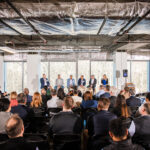
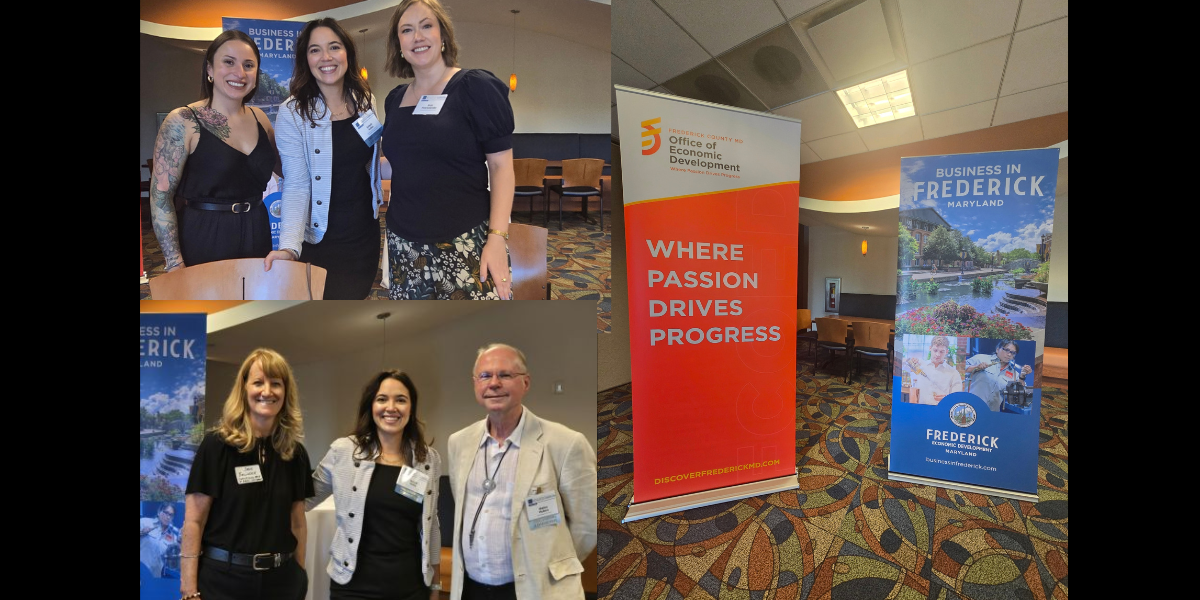
Scientists, industry professionals, economic-development leaders, and community partners gathered September 9, at Matan at Riverside for the Bio Networking Happy Hour, an evening focused on connecting people across Frederick’s life sciences and technology ecosystem. The event was hosted by Matan Companies and sponsored by the City of Frederick Department of Economic Development and the Frederick County Office of Economic Development, following the Frederick National Laboratory for Cancer Research Technology Showcase earlier that day, extending the day’s focus on scientific innovation and collaboration across the region.
Frederick Mayor Michael O’Connor pointed to public-private cooperation as central to the community’s strength: “It really has to be a collaborative environment between the public sector, the private sector and our nonprofit sector for this community to work.”
Local Support Behind the Event
The happy hour was supported by the Frederick County Office of Economic Development and the City of Frederick Department of Economic Development, with Matan Companies as event sponsor. Solash Aviles, Senior Business Development Manager, Life Science & Technology, Frederick County Office of Economic Development, and Mary Ford-Naill, Economic Development Manager, City of Frederick Department of Economic Development, discussed how their offices help businesses connect with local resources, and recognized Matan Companies for its ongoing support of the region’s life sciences sector. The conversation also touched on commercial and development opportunities at Matan at Riverside itself. Ford-Naill encouraged attendees to reach out to the economic-development team about establishing or growing a business in Frederick.
A Ninth Year, Back In Person
Walter Hubert, Scientific Program Director in the NCI Frederick Office of Scientific Operations, described this year’s gathering as the ninth iteration of the networking event. After several years of virtual and hybrid programming, the organizers returned to a fully in-person format. As Hubert put it, “this is the way you do networking.”
The format created space for informal conversations among people working across different parts of Frederick’s life sciences ecosystem—conversations that can be difficult to replicate in a virtual setting.
What the Technology Showcase Covered
The networking event followed the Frederick National Laboratory Technology Showcase, adding another dimension to the day’s focus on connection and collaboration.
Motho Mlalazi-Oyinloye described the showcase as an opportunity for researchers, pharmaceutical and biotechnology companies, investors and other organizations to learn about technologies from the National Cancer Institute (NCI) research community and explore potential opportunities for collaboration, licensing and commercialization. She noted that these opportunities are not limited to large organizations; NCI can engage with small businesses, startups and other partners through a range of collaborative arrangements.
For Tomilola Aderupoko, the showcase demonstrated the value of making complex scientific and development topics accessible beyond a specialized audience. Although drug development was not her primary area of work, she said she found the sessions insightful and particularly appreciated learning more about the U.S. Food and Drug Administration (FDA) process and development timelines.
A Community Connected Across Generations
A conversation between Hubert and BioBuzz Community Contributor Sukanya Chowdhury surfaced a shared connection to the former SAIC Frederick Protein Purification and Expression Lab, where Chowdhury worked from 2000 to 2004 — a small moment underscoring how the region’s current life sciences ecosystem builds on decades of prior work and relationships.
Strong life sciences communities are built on more than science — they’re built on relationships, collaboration, and the ability to connect people and ideas. From technology transfer and commercialization to informal conversations between colleagues, the evening was a reminder that a strong life sciences community takes shape not only in the laboratory, but in the connections made beyond it.