As biotech faces tighter capital and global competition, leaders from Research Bridge Partners, CvilleBioHub, VIPC and ITIF share how collaboration, talent, and anchor partnerships can fuel the next generation of innovation.
At a time when biotech valuations are under pressure, venture funding is tightening, and early-stage companies face steeper paths to capital, one truth is becoming inescapable: the next wave of life science growth will be built on collaboration, not competition.
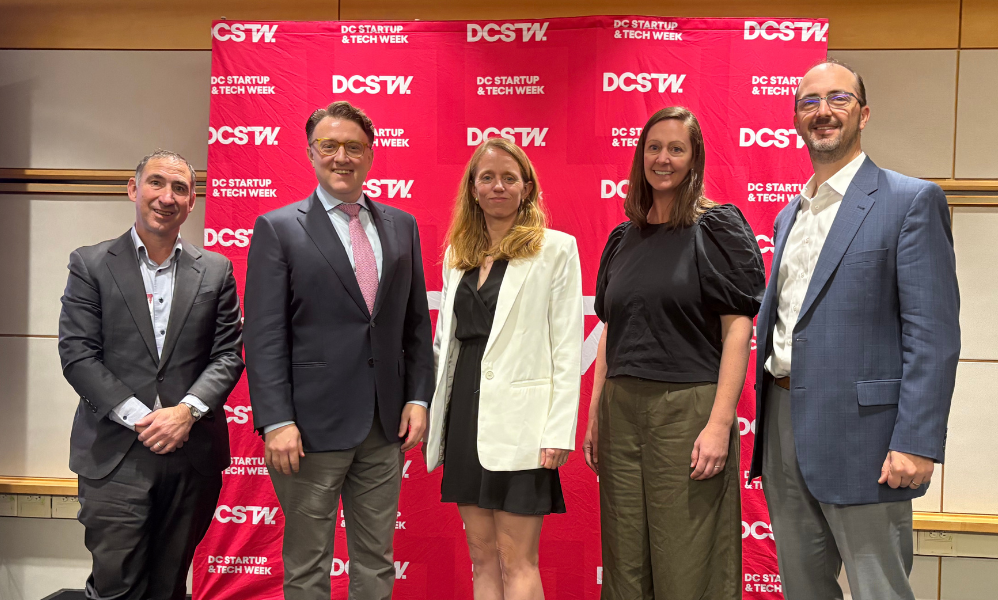
That imperative was front and center during DC Startup and Tech Week (DCSTW), where innovation leaders from across sectors gathered to explore the future of regional ecosystems. As part of the event’s Life Science Track, hosted by BioBuzz, a dynamic roundtable tackled a defining question: What will it take to build America’s next-generation life science ecosystem?
Moderated by Chris Frew, CEO and Founder of BioBuzz Networks, the discussion brought together Joe Benevento, CEO of the Virginia Innovation Partnership Corporation (VIPC); Dr. Lydia McClure, CEO of Research Bridge Partners; Nikki Hastings, President or CvilleBioHub and Stephen Ezell, Vice President for Global Innovation Policy at the Information Technology and Innovation Foundation (ITIF).
Their conversation offered a candid, forward-looking roadmap for what comes next—spanning policy, talent, research translation, and the evolving role of anchor institutions.
1. Close the Innovation Gap
Innovation in America remains deeply uneven. As Ezell shared,
“Half of all U.S. innovation jobs are concentrated in just 40 counties—and most of those are in California and Massachusetts.”
That concentration, he noted, threatens the nation’s ability to compete globally. It’s why Ezell helped shape the Regional Tech Hubs program within the CHIPS and Science Act, a $10 billion federal initiative (with $540 million deployed so far) designed to catalyze high-tech growth in emerging markets like Richmond and Baltimore.
“We’re finally seeing serious focus on technology-based economic development in the regions that were left behind,” Ezell said. “That’s how we close the opportunity gap—and future-proof U.S. leadership in biotech.”
2. Unlock University Innovation
If America wants to lead the next century of biopharma, it must fix the disconnect between academic research and real-world commercialization.
“University R&D has grown from $65 billion to $110 billion in the last decade,” Benevento noted. “But the number of startup spinouts and active licenses has stayed flat.”
To bridge that gap, Virginia launched Lab2Launch, a first-of-its-kind collaboration among six R1 universities to simplify and standardize tech transfer.
“We’re taking the process from nine months down to 30 days,” Benevento said. “No upfront fees, no maintenance costs, and the most founder-friendly terms in the country.”
By removing friction, Benevento believes more discoveries will find their way into companies—and ultimately into patients’ hands.
“If we’re going to compete globally, we need more shots on goal.”
3. Build Ecosystems People Choose to Join
For McClure, innovation thrives when founders have the freedom to grow—not when they’re bound by geography.
“It’s inevitable that early-stage startups begin close to universities,” she said. “But eventually they need to go where they can reach patients fastest and most cost-effectively. The goal isn’t to tether them—it’s to empower them.”
She pointed out that the D.C.–Maryland–Virginia (DMV) corridor is uniquely positioned because of its diversity.
“We don’t all have to row in the same boat. We can experiment, compete in a friendly way, and still rise together.”
Nikki Hastings, Executive Director of CvilleBioHub, echoed that sentiment.
“You can’t force people to stay in an ecosystem,” she said. “You have to create one they want to be in.”
Over the past decade, CvilleBioHub has nurtured a thriving network of more than 75 companies by emphasizing connection and consistency.
“We’ve hosted the same Tuesday night event every month for 10 years,” Hastings said. “Eighty people show up, and everyone leaves with a new connection. That consistency builds trust—and trust builds ecosystems.”
4. Redefine Talent and Trust
All panelists agreed: the future of innovation rests on talent.
Moderator Chris Frew emphasized that ecosystems must think about talent development from “techs to execs” to build both job-ready and investment-ready talent pipelines.
“We can’t just train for today’s jobs,” he noted. “We have to prepare the talent needed to scale companies, lead teams, and attract capital.”
Benevento reinforced this in how Virginia is operationalizing that mindset. “We’re building pathways that make talent both job-ready and investment-ready,” he said.
McClure added that the decentralization of work has also opened new opportunities to access expertise.
“Very little of our talent is local—it’s all remote,” she said. “That has drawbacks, but it also means the right expertise can plug in from anywhere.”
She also underscored that the talent conversation extends beyond scientists and CEOs. “There’s an entire layer of mid-career professionals—program managers, regulatory experts, data specialists—who hold ecosystems together,” she said. “We need to nurture those roles with the same intention we give to founders.”
Hastings highlighted that flexibility is becoming a key asset for growing regions.
“There’s been a huge rise in fractional leadership—experienced executives and scientists who split time across multiple startups,” she said. “That flexibility has been a game-changer.”
And as Benevento pointed out, great ecosystems run on more than skill—they run on trust.
“The scarcest resource for an entrepreneur is time,” he said. “For big companies, it’s certainty. If we can deliver both, we win.”
“When companies like Eli Lilly and AstraZeneca invest here, they’re not just bringing capital—they’re becoming talent magnets,” Benevento added. “They help shape the training pipelines, attract suppliers, and validate the region’s potential.”
BioBuzz’s new talent marketplace can help Companies looking for Fractional Talent. Visit BioBuzz to learn more.
5. Anchor with Big Biopharma
The conversation also highlighted how anchor tenants play such a critical role in an ecosystem. Not only large pharmaceutical companies, but also committed investors, can act as anchors that transform regional ecosystems.
Virginia’s recent wave of investment from Eli Lilly, AstraZeneca, and Merck—totaling more than $13 billion in pharmaceutical manufacturing projects—underscores the state’s growing competitiveness. Benevento credited Virginia’s proactive, business-friendly approach as a major factor.
“When companies come to Virginia, they find a state that moves at the speed of business,” he said. “We have predictable regulations, fast decision-making, and public partners who understand what it takes to get from groundbreaking to production.”
These global anchors not only strengthen supply chains and capital flows but also validate a region’s reputation as a reliable home for innovation. “When big pharma chooses to build here, it sends a powerful signal,” Benevento said. “It tells the world that this region is ready to compete.”
6. Compete Through Collaboration
While competition fuels innovation, the panel agreed that collaboration sustains it. The DMV region offers a living example of cooperative growth, from shared lab spaces to joint workforce programs and interstate investment strategies.
Ezell highlighted the value of specialization balanced with collaboration.
“Communities shouldn’t try to be good at everything,” he said. “They should identify where they can be best in class—and then align with neighbors who complement their strengths.”
Hastings added that ecosystem maturity matters.
“Early on, go broad. Let the strongest ideas bubble up naturally. As things mature, focus will emerge organically.”
7. Make Policy and Patient Capital the Backbone
Policy and patient capital remain the quiet engines behind every successful innovation hub. McClure pointed to Texas’s Cancer Prevention and Research Institute (CPRIT) as a model for comprehensive State support. This program committed over $4B investment into a cancer ecosystem in TX that has had tremendous impact across the state.
“They have everything wrapped around one program—faculty recruitment, infrastructure, clinical trials, product development,” she explained. “It works because it’s coordinated.”
Hastings added that programs like GO Virginia and VIPC created the foundation for the state’s current biotech boom.
“Those early investments gave us credibility and momentum,” she said.
Ezell closed with a reminder that America’s biotech dominance was a policy choice.
“We became the world leader in biopharma through intentional policy—Bayh-Dole, the R&D tax credit, SBIR grants,” he said. “But that leadership is at risk if we don’t remain deliberate stewards of innovation.”
The Takeaway
As the session concluded, Frew summarized the shared mission.
“We’re all builders—of companies, of communities, of opportunity,” he said. “The question isn’t whether we’ll build the next generation of life science innovation. It’s whether we’ll build it together.”
In a tightening market, that vision may be the ultimate competitive advantage.