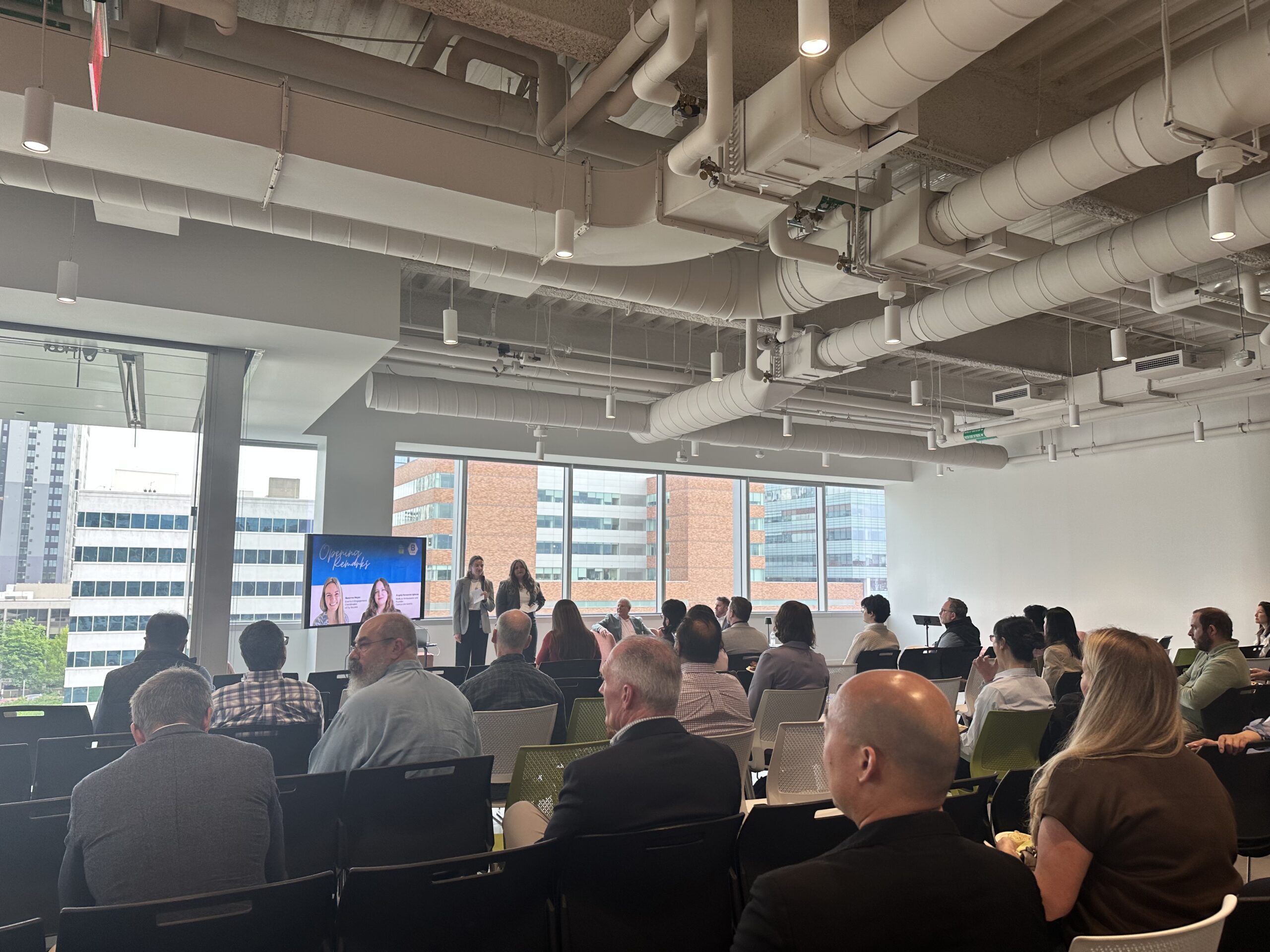
The room was gathered to support cancer research, but the conversation quickly widened into something larger. At Climb for a Cure — a Philadelphia fundraising event hosted at B+Labs by Brad Watts of Conner, Strong & Buckelew as part of the Timmerman Traverse fundraising climb (donate here) supporting the Damon Runyon Cancer Research Foundation — the night’s most consequential moment unfolded not on the mountain, but on stage.
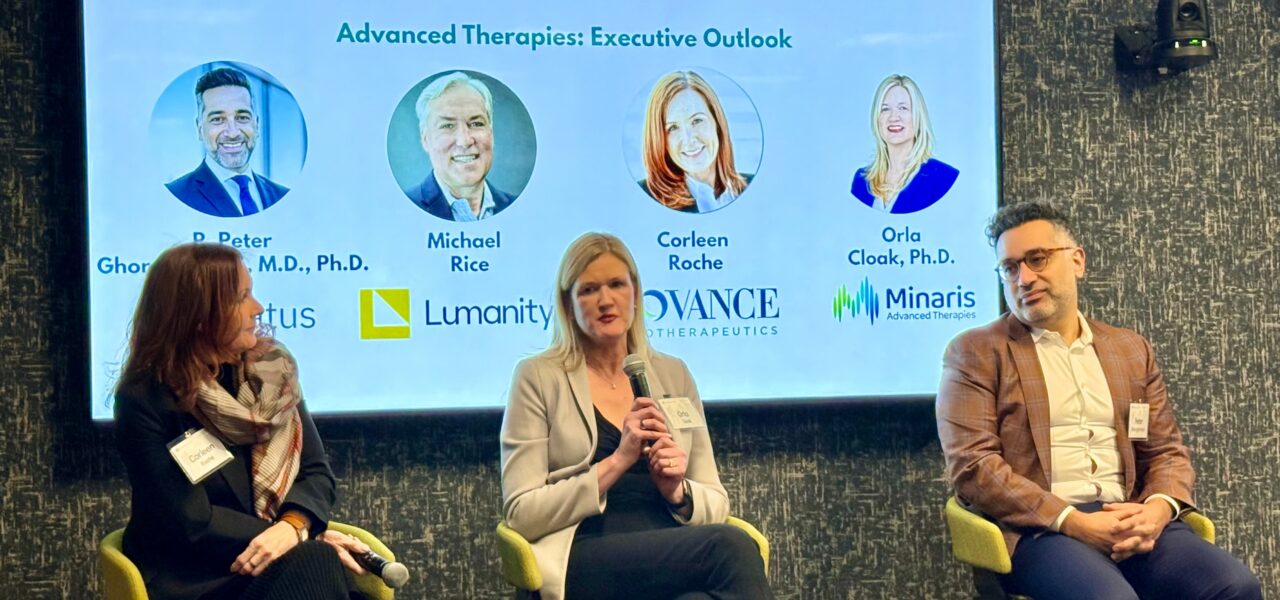
There, a featured panel titled “Executive Outlook on Advanced Therapies” brought together senior leaders from across the Philadelphia cell and gene therapy ecosystem to confront a shared reality: the science has arrived, but the system around it is still catching up.
Moderated by Michael Rice of Lumanity, the discussion featured Orla Cloak, PhD, CEO of Minaris Advanced Therapies; Corleen Roche, CFO of Iovance Biotherapeutics; and P. Peter Ghoroghchian, MD, PhD, founder and CEO of Latus Bio.
Together, they offered something rarer than optimism: a grounded, candid assessment of what it will take for advanced therapies to mature into a durable, investable, and scalable pillar of modern medicine.
From Promise to Performance
Cell and gene therapies now number more than 40 FDA-approved products, many of them transformative for patients with few or no options. Yet the sector’s commercial track record remains uneven. Manufacturing complexity, reimbursement friction, regulatory uncertainty, and capital constraints continue to challenge even the most scientifically compelling platforms.
That tension framed much of the discussion.
For Corleen Roche, who recently joined Iovance Biotherapeutics as CFO during its first commercial phase, approval marked the beginning—not the resolution—of risk. Iovance’s tumor-infiltrating lymphocyte (TIL) therapy for advanced melanoma represented a historic milestone as the first approved adoptive cell therapy for solid tumors. But post-approval, Roche emphasized, execution challenges compound rather than recede.
Commercial success, she argued, depends less on the regulatory label than on whether patients can realistically access therapy. “I think you have to focus on the patient journey,” Roche said. “If you focus on the patient journey, it will follow.” That perspective has driven Iovance to expand treatment beyond major academic centers into community settings, reducing travel and administrative burdens that can quietly suppress adoption. “We wanted to get the product to the patient so the patient doesn’t have to come to the product,” she added.
“We’ve been going through a rapid growth period, and that’s a really critical period,” Roche said, pointing to the need to balance speed, cost, and scalability. The goal, she explained, is to “efficiently make the product and treat the patients in the most efficient way possible,” ensuring the company has the capitalization required to keep moving forward.
The insight reframed post-approval access not as a reimbursement issue alone, but as an operational one—requiring deliberate infrastructure, disciplined spending, and organizational focus at precisely the moment when companies are under pressure to grow quickly.
Manufacturing Is No Longer a Back-End Problem
If commercialization is the test, manufacturing is often where advanced therapies quietly succeed—or fail.
Cloak, a Greater Philadelphia resident for nearly two decades and one of the region’s most experienced CDMO leaders, framed the issue with characteristic directness. After 17 years inside a global CDMO, she now leads Minaris Advanced Therapies, a company intentionally designed around a narrower mandate: cell and gene therapy manufacturing as a core competency, not a secondary service line.
One of the most persistent misconceptions in the field, Cloak said, is assuming that processes optimized for discovery will hold up in GMP environments. “I like to say R&D is not GMP,” she told the audience. “And I think sponsors really underestimate that.”
Minaris was formed through the consolidation of legacy regenerative medicine and advanced therapies capabilities, including significant infrastructure in Philadelphia’s Navy Yard. That heritage reflects lessons learned from the earliest waves of commercial cell therapy, when fragile processes and inflexible manufacturing models often collided with real-world demands.
Cloak emphasized that today’s environment—defined by tighter capital and higher investor scrutiny—demands a different approach. Rather than treating manufacturing as a one-time technology transfer, she argued for an iterative, collaborative model. “It has to be a partnership,” she said, noting that sponsors are increasingly focused on how early manufacturing decisions affect long-term cost of goods, risk, and commercial viability.
Capital Has Changed the Rules
That shift was articulated most starkly by Ghoroghchian.
A physician-scientist and serial founder, he described a capital market that has fundamentally reset expectations for advanced modality companies. “The bar has become incredibly high,” he said, explaining that early clinical programs must now demonstrate not just safety, but meaningful signals of efficacy to attract sustained investment.
At Latus Bio, that reality has driven a relentless focus on efficiency. “To raise a Series B today, you have to have enough capital in your Series A to get to a meaningful clinical endpoint,” Ghoroghchian noted. The implication is clear: platforms must be designed from the outset with manufacturing feasibility and commercial relevance in mind.
He also challenged the long-standing assumption that acquisition by large pharma is the default goal for emerging biotechs. “If you’re waiting to develop technology to be bought out, that’s going to be an extremely difficult bar,” he said, arguing instead for building toward therapies that can realistically become first-line treatments.
In that context, manufacturing partners are no longer interchangeable vendors. They are strategic enablers—or constraints—on whether a company can survive long enough to realize its vision.
Philadelphia as a Quiet Throughline
While the panel ranged across global capital markets, FDA policy, and China’s growing role in biotech innovation, a quieter signal ran underneath the discussion: Philadelphia stands out as a connective hub for advanced therapies.
From academic spinouts and platform companies to commercial-stage cell therapy developers and specialized Advanced Therapies CDMOs like Minaris, the region increasingly reflects the full lifecycle of advanced therapeutic development. Cloak’s long-standing presence in the region underscores that evolution. What once required stitching together expertise across geographies can now, in many cases, be executed within a single, dense ecosystem.
As the field matures, that integration matters. Advanced therapies demand more than breakthrough science; they require manufacturing depth, regulatory fluency, and operational leadership capable of navigating uncertainty at scale.
Traversing the Next Summit for Advanced Therapies
The evening began with a climb—one individual pushing upward to raise funds for cancer research. It ended with a conversation about a different ascent: the long, uneven rise of advanced therapies from scientific promise to sustainable reality.
As the panel made clear, the next phase of the field will be defined less by discovery than by execution. Manufacturing, once treated as a downstream function, is now a central determinant of whether innovation survives the transition to scale. In that environment, infrastructure itself has become a form of leadership.
“When cell and gene therapy started, initially it was really the promise—the clinical promise of the data. And I think now it’s much more commercially focused. The science is absolutely brilliant, it’s really innovative, but can you commercialize it? Can you produce it? Can you produce it at the right cost? And what does that look like?
I think that’s really where investors are focused now, and I think from a sponsor perspective, the mindset is gradually shifting.”
This statement from Orla Cloak signaled how Minaris Advanced Therapies, under her leadership, is leaning into that responsibility to ensure that manufacturing is not as a static handoff, but a collaborative, adaptive discipline that evolves alongside the science.
The science behind advanced therapies has largely proven its potential. What remains uncertain is whether the ecosystem can move with the same precision, flexibility, and discipline required to deliver those therapies reliably to patients.
If the night offered a final takeaway, it was this: the future of advanced therapies will not be decided at the peak of ambition, but in the steady, demanding climb that turns breakthrough ideas into lasting impact.