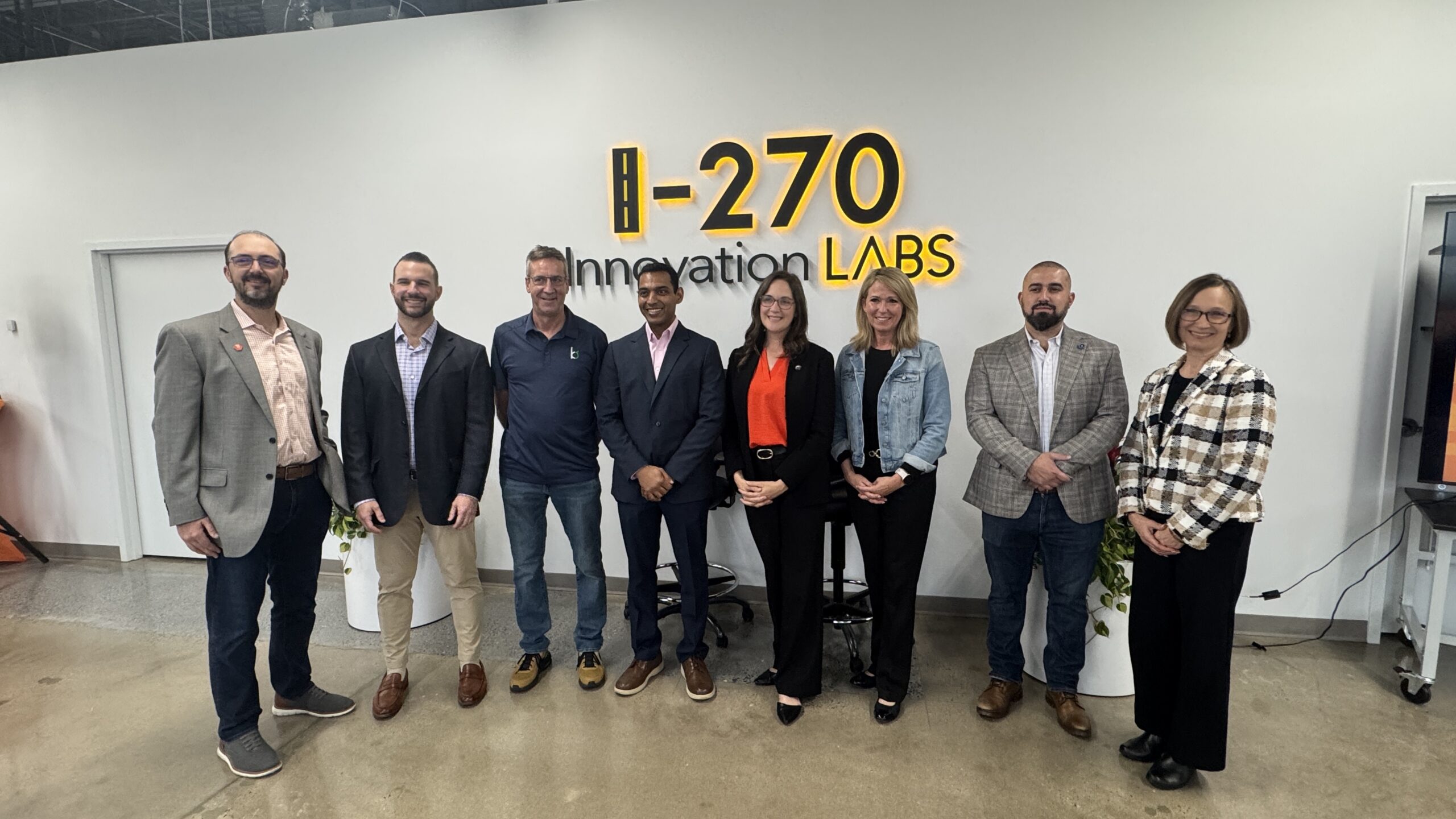
At I-270 Innovation Labs in Frederick County, the room filled past capacity—an audience standing shoulder to shoulder to unpack what, on paper, looks like a simple story: a $2 billion investment into Maryland’s life sciences ecosystem.
But as the conversation unfolded, it became clear that the number itself is almost beside the point.
“We see headlines all the time… $2 billion investment in Maryland. That’s a great headline,” said BioBuzz CEO Chris Frew as he opened the evening. “But a lot of times we don’t really know what goes on behind it.”
That gap—between announcement and execution—became the real story of the night.
Hosted with lead sponsor Heffron and supported by Neu-Ion, the event brought together leaders across AstraZeneca, academia, workforce development, and state leadership. The goal wasn’t to celebrate the investment. It was to interrogate it—what it demands, what it unlocks, and whether Maryland is structurally ready to deliver on it.
Frederick County Executive Jessica Fitzwater set the local context with confidence, pointing to a region that has quietly built one of the country’s most interconnected life sciences ecosystems.
“We are one of the nation’s leading life sciences clusters where innovation, talent and opportunity truly do intersect,” she said, emphasizing the collaboration between industry, education, and government that defines the region.
That ecosystem—more than 130 life science companies, proximity to federal labs, and a growing talent pipeline—is precisely what helped attract AstraZeneca’s expansion. But as the fireside chat with AstraZeneca’s Mark Benesch made clear, attraction is only the first step.
Execution is where the real work begins.
Benesch, who leads capital projects for the Americas, framed the investment not as a standalone initiative, but as a direct extension of AstraZeneca’s broader ambition: launching 20 new medicines and doubling the company’s size to $80 billion by 2030.
“It’s sort of like the physical manifestation of that ambition,” he said. “You don’t double your size as a company without expanding your physical footprint.”
That physical footprint, in this case, includes expanding AstraZeneca’s already largest global biologics manufacturing site in Frederick—effectively doubling its capacity—while simultaneously building out new clinical manufacturing infrastructure in Gaithersburg.
But the more revealing insight wasn’t about scale. It was about complexity.
“When you’re launching a project of this size… I think of it like launching your own company,” Benesch said.
That means aligning hundreds of stakeholders across functions most people never associate with biomanufacturing—finance, HR, IT, supply chain, government affairs—alongside external partners ranging from engineering firms to utility providers. It’s not just a construction project. It’s a coordinated system build.
And increasingly, it’s a race.
Maryland’s advantage, Benesch noted, lies in its ecosystem density—its universities, vendors, and experienced partners. But he was equally clear that proximity alone won’t win the next wave of investment.
“We’re looking for partners that don’t just enable [our mission], but really accelerate it,” he said.
That distinction—enable versus accelerate—hung over the rest of the discussion.
Because if the fireside chat exposed the machinery behind the investment, the panel that followed tackled a harder question: what determines whether that investment actually translates into sustained regional growth?
Moderated by Heffron’s Tarek Geblaoui, the panel brought together Maryland Tech Council CEO Kelly Schulz, Hood College’s April Bolton, and Kite Pharma’s Trushar Agrawal to explore the so-called “ripple effect.”
The implication was clear: ripple effects are not guaranteed. They are built.
Maryland has long marketed its assets—federal proximity, research institutions, a skilled workforce—but the panelists pointed toward a more nuanced reality. The next phase of growth will depend less on what the state has, and more on how effectively those assets are mobilized.
Workforce emerged as a central theme, not just in terms of availability, but alignment. Training programs, academic pipelines, and industry needs must move in sync—especially as advanced manufacturing models evolve and demand new skill sets.
Infrastructure followed close behind. Facilities like I-270 Innovation Labs and FITCI were highlighted as critical on-ramps for early-stage companies, but also as signals of a broader shift toward flexible, scalable environments that allow companies to grow without friction.
And then there’s coordination—the connective tissue that determines whether capital, talent, and infrastructure actually function as an ecosystem rather than a collection of assets.
That’s where the tension lies.
Because while Maryland has the ingredients, it is operating in an increasingly competitive landscape. Neighboring states are making aggressive plays for biomanufacturing dominance, often pairing capital with speed, incentives, and streamlined execution.
Which brings the conversation back to where it started.
A $2 billion investment may grab attention. But what follows—how quickly facilities are built, how effectively talent is deployed, how seamlessly partners align—is what determines whether that headline becomes a turning point or just another data point.
For Benesch, the hope is that this moment becomes something more.
“My personal hope… is that this does spark other companies… to take a look at why we’ve chosen to double down in Maryland,” he said.
That’s the real signal.
Not the size of the investment—but whether it triggers the next one.