A full day in Philadelphia where startups, investors, and partners came together to define what actually moves science forward
A Space Built for Momentum
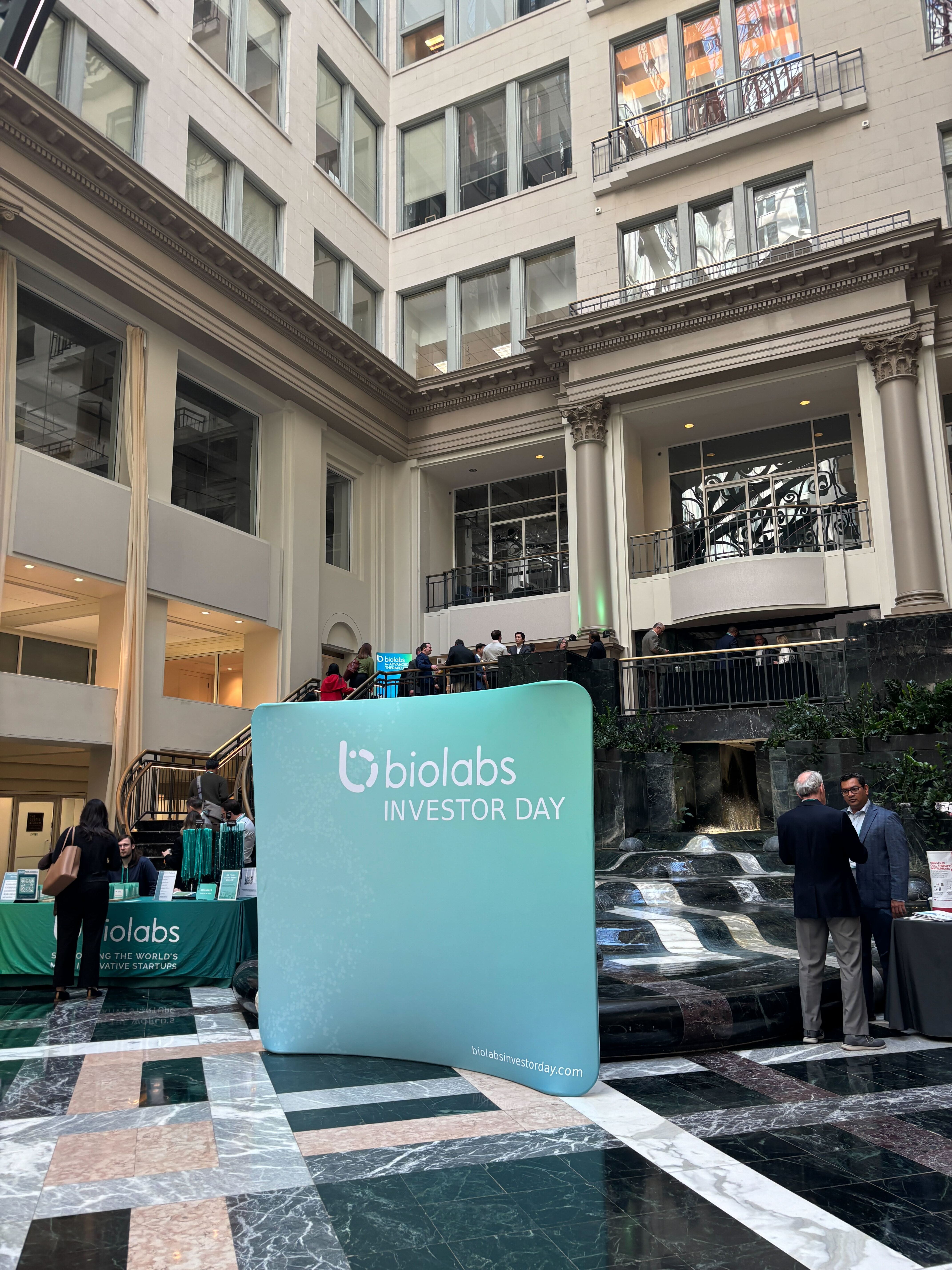
There’s something about the Curtis Building that sets the tone before anything even begins. The scale, the light, the weight of history in the architecture—it creates a quiet sense that what happens inside matters. And within it, BioLabs for Advanced Therapeutics has built something equally intentional: a space where early-stage science is not just explored, but pushed toward becoming something real.
On April 21, 2026, that space filled early and stayed full. Founders, investors, scientists, and operators moved easily between conversations, reconnecting, meeting for the first time, exchanging ideas before the first pitch even began. It didn’t feel like a passive event—it felt like a system in motion.
As one attendee, Leonardo A. Guercio, from the Colton Center for Autoimmunity at the University of Pennsylvania, put it:
“What I really like about it is that it brings everybody across the ecosystem together… academics, private sector companies, early-stage startups, investors. It’s really just an opportunity to see what’s going on in the city.”
That energy carried throughout the entire day.
A Day Designed Around Connection
The structure of Investor Day made that momentum visible. From morning registration and networking breakfast to multiple rounds of investor introductions, three pitch sessions, and built-in networking breaks, the day was intentionally designed to create repeated moments of interaction. A patient spotlight grounded the science in real-world impact, while a midday panel added strategic perspective before the day closed with awards and continued conversations.
Rather than a single sequence of presentations, the event created rhythm, giving people time to engage, reconnect, and build on conversations throughout the day.
Translating Science Before It Hits the Stage
Before the first company stepped up to pitch, the room was given something just as important as capital or exposure, context. Maiken Scott, from WHYY, opened the pitch sessions by doing what she does best: making complex science understandable. As moderator, she didn’t just introduce speakers—she translated them. Each company’s work was framed in clear, accessible language, creating a shared starting point across a room filled with scientists, investors, operators, and first-time attendees. That shift mattered.
Because while the technologies being presented were advanced, the ability to understand them, quickly and collectively is what allows decisions to happen in real time. Her role made the pitches more than technical presentations; it made them legible across the entire ecosystem.
Drawing from her background in health and science storytelling , she also anchored the session in something deeper than innovation alone. The work being presented wasn’t just about platforms or pipelines but it was about where those efforts ultimately land. Patients. Families. Outcomes that exist far beyond the room.
30 Startups, One Shared Reality
Across the three pitch sessions, more than 30 startups presented a wide range of innovations spanning oncology, neurodegeneration, women’s health, rare disease, and diagnostics.
Some companies focused on platforms enabling technologies for delivery systems, cell therapies, or data-driven approaches. Others were advancing targeted therapeutics, from immunology to chronic disease. Diagnostics also stood out, with approaches ranging from tear fluid analysis to breath-based cancer detection. But across all of them, one theme emerged clearly: The challenge is no longer just discovery, it is execution. How do you move faster? How do you scale? How do you translate something promising into something that actually reaches patients? That tension showed up in real time. Some founders delivered fully connected narratives—science, strategy, and pathway aligned. Others reflected a more common stage: strong science, still working to define how it fits beyond the lab.
What Stood Out—and What Won
By the end of the sessions, a few companies clearly captured the room’s attention—but one, in particular, resonated across with both investors and attendees. Hayflick Therapeutics was awarded Investor Favorite, reflecting not just interest, but alignment with what the room was looking for. The company is advancing a platform targeting the mTOR pathway through localized, micro-dose delivery of rapamycin, an approach designed to address cellular aging at the molecular level while maintaining a clear path toward regulatory development.
What stood out wasn’t just the science; it was the clarity behind it: a defined direction, a clear positioning, and a strong sense of how the work moves forward.
Investors Are Looking for More Than Science
That shift was reinforced by the investors in the room. From early-stage funds to pharma-backed innovation groups, the message was consistent: capital is still there—but expectations have changed. Investors are no longer evaluating science in isolation. They are looking for strategic alignment, execution readiness and a credible path to development and commercialization Support is no longer just financial. It is operational, strategic, and increasingly hands-on, helping founders move from academic discovery into company-building mode.
A Panel That Reframed the Day
Midway through the event, the BioStrategy Partners panel shifted the lens. If the pitches showed what is being built, this conversation explored how those ideas actually move forward. The panelists described a clear evolution: the traditional model, where academia discovers and industry steps in later, is no longer sufficient. Instead, collaboration is happening earlier, often before a technology is fully defined. As one speaker explained:
“We really sit at the table at the very early stages… to make sure everybody is aligned from the get-go.”
That shift reframed everything.
Early Alignment Is the New Advantage
The panel made one thing clear: early engagement is no longer optional. Partnerships are forming sooner, and they’re bringing in perspectives that used to come much later:
- Clinical application
- Regulatory strategy
- Market access
- Real-world implementation
Another panelist reinforced how these collaborations now extend much further than before, carrying ideas from discovery through translation and into the clinic. The takeaway was simple, but significant: If these elements aren’t considered early, they become barriers later.
A Moment That Grounded the Day
Amid the momentum of pitches, strategy, and investment conversations, the patient spotlight shifted the room in a way nothing else could. Rob Long of Uplifting Athletes took the stage, not as a founder or investor, but as someone living on the other side of the work being presented. A brain cancer survivor, his presence reframed the entire conversation. His story wasn’t about timelines, funding rounds, or technical milestones. It was about what happens when all of those things come together, years, sometimes decades, after the initial discovery.
“I think I stand here… because of the work that was done decades before I was ever diagnosed.”
In a room focused on what’s next, his words anchored everyone in what’s at stake. Because behind every platform, every molecule, every pitch deck, there is a future patient who will never see this stage, but will live with the outcome of the decisions made here. It was a reminder that progress in biotech is not measured only in milestones or exits, but in time: time extended, time restored, time made possible through work that often begins long before anyone knows who it will help. For a moment, the pace of the day slowed. And the purpose became unmistakably clear.
An Ecosystem Taking Shape
Between sessions, the real work continued in the margins. Conversations flowed. Introductions turned into follow-ups. Ideas moved from concept to connection. Philadelphia’s life sciences ecosystem is no longer just growing—it’s organizing. And spaces like BioLabs are accelerating that by bringing together the pieces that need to align: science, capital, infrastructure, and strategy. As Guercio noted, it’s not just about individual companies—it’s about seeing the system as a whole, and where it’s heading next.
What This Day Made Clear
By the time the event wrapped, there were no final answers, but there was clarity. Investor Day wasn’t just about showcasing innovation. It was about understanding what is ready to move forward. The science is there. The ambition is there. But increasingly, what determines progress is something else: clarity, alignment and the ability to build the path alongside the science
As BioLabs Investor Day continues to grow, it’s becoming more than an event. It’s a signal of, not just of what’s being built, but of what’s ready to move next.