The National Security Commission on Emerging Biotechnology (NSCEB) brought its Biotech Across America Roadshow to Rockville, Maryland on September 14, 2026, with Commissioner Dov Zakheim visiting United States Pharmacopeia (USP) to meet with state officials and industry leaders on strengthening U.S. biotech supply chains as China pushes for global biotech dominance.
Zakheim framed the stakes bluntly: “Maryland is addressing biotech supply chain vulnerability head-on. The United States has lacked the infrastructure to scale biotechnology products and bring them to market, and it was clear today that states like Maryland would benefit from more effective coordination at the federal level to fully achieve supply chain resilience.”
A Roundtable on Federal Coordination and Biomanufacturing
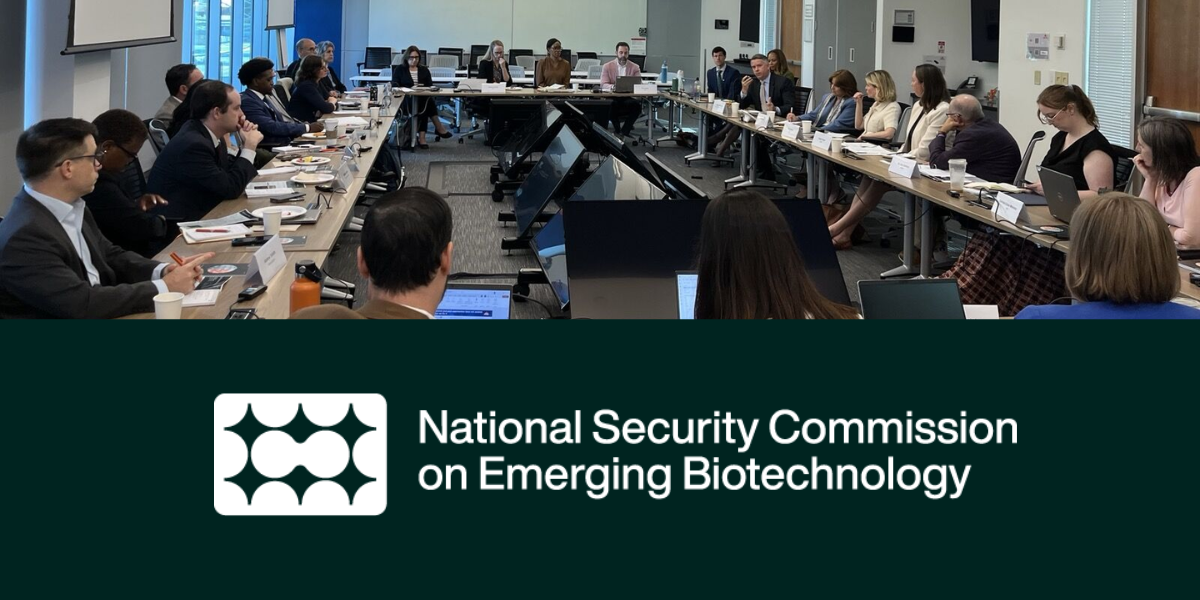
The visit centered on a roundtable exploring what a coordinated federal biotechnology strategy could look like and how it would benefit Maryland’s industry and domestic supply chain security, with discussion focused on expanding biomanufacturing capacity, growing the biotech workforce, and identifying infrastructure gaps. Participants noted Maryland’s existing base of federal biotech assets, including the NIH and NIST, and a long history of federal partnership among the state’s institutions.
Brad Gillenwater, Life Sciences Manager for the Maryland Department of Commerce, tied the conversation to the state’s broader standing: “Today’s Biotech Across America Roadshow roundtable showcased exactly why Maryland’s life sciences sector paces the nation in jobs, investment, and innovation. We are grateful to the National Security Commission on Emerging Biotechnology for the opportunity to discuss how Maryland can further strengthen its leadership in biomanufacturing, and we hope to continue these conversations with our private-sector and government partners in the near future.”
The roundtable drew participants including AstraZeneca, BioHub Maryland, the Johns Hopkins University Applied Physics Lab, MilliporeSigma, NIH’s National Center for Advancing Translational Sciences, NIST, Maryland Department of Commerce , TEDCO, United States Pharmacopeia and congressional offices representing Rep. Andy Harris, Rep. April McClain Delaney, Sen. Angela Alsobrooks, and Sen. Chris Van Hollen.
Maryland’s Pitch: A Pipeline Other States Don’t Have
TEDCO President Tammi Thomas positioned Maryland as already operating the kind of system the Commission wants to see nationally: “Maryland already operates the kind of coordinated, end-to-end biotech pipeline the Commission’s report calls for nationally, from early-stage research funding through venture capital, and we’re grateful for the opportunity to share how that pipeline is working, and where it can grow, with national leaders.”
Emily Kaine, M.D., Senior Vice President, Global Health and Manufacturing Services at USP, pointed to what still needs to be built around that pipeline: “This NSCEB-led convening underscored the importance and power of working together across federal, state, private and public entities to harness and scale America’s innovation engine. Key additional enablers will also include smart policy, sustained investment and, also, international standards to facilitate research and development, reduce uncertainty and streamline regulatory pathways.” The Rockville stop is part of NSCEB’s broader roadshow highlighting the companies, academic institutions, workforce programs, and policy initiatives shaping U.S. biotechnology, building on the Commission’s comprehensive report to Congress published in April 2025.
About NSCEB
The National Security Commission on Emerging Biotechnology is a time-limited, high-impact legislative branch advisory entity whose purpose is to advance and secure biotechnology, biomanufacturing, and associated technologies for U.S. national security and to prepare the United States for the bioindustrial revolution. The bipartisan Commission is composed of Congressionally-appointed Commissioners with members from both the Senate and the House of Representatives as well as experts from industry, academia, and government.